Categories
Ramblings by Hal

Ramblings, Driving part 4 of 3

By Hal Collier

I swear this is the last Ramblings of Driving!

This will be part 4 of a planned trilogy. I have been accused of being verbose (wordy) or loquacious (talkative). I had to look up both words. I started writing my Ramblings for cops, then found out that they were being forwarded to non-cops, which was fine with me. I learned to stop using cop vernacular and abbreviations that only a cop might know. I also got e-mails from former partners, ‘Hey Hal what about this or that?’, and occasionally I get, ‘Do you remember the time you drove over my foot?’ Come on, I only did that twice! Each of these brings an additional paragraph or two. This is the last Ramblings on driving, I think!

Pursuit driving is whole new ball game. You don’t get to pick the streets, the speed, or the chances you take. It’s a little like riding in the last car of a roller coaster—you’re just along for the ride. You can terminate a pursuit anytime you want. That decision is usually based on your experience and your will to see your kids move out of the house and get married.

I’ve been in a lot of pursuits and as I stated before, I hate them. Some were easy; some made me want to be an electrician like my dad. The risks you take are seldom worth the punishment the culprit will receive from a judge. Most cops’ biggest problem during a pursuit is tunnel vision and your ego. Ego first. The longer you’re a cop the smaller your ego gets! Ego kicks in when some dirt bag challenges your authority by failing to stop at your command. A young cop will chase this guy for as long as it takes, no matter how big the risks! Tunnel vision can be just as dangerous. All you see is the bad guy in front of you, you don’t know how fast you’re going, or how many close calls you just had. A few close calls wised up some of us, others ended up on the Los Angeles Police Memorial Wall!

On the LAPD, we deployed 2 man cars. This made driving easier. The passenger officer could handle the computer and the radio. He was also in charge of checking cross traffic at intersections and in some cases telling you to stop chasing this nut. One man cars were required to relinquish the pursuit when a two man car joined in. It was a challenge to drive, broadcast, and watch for that little old man who didn’t hear your siren—often he will turn right in front of you.

Other driving incidents that most people never think of, including some cops, is police vehicle vs suspect on foot? The LAPD often conducted what they called “Buy-Bust Operations.” It not what your think, It has nothing to do with paying a prostitute or a part of the female anatomy. “Buy Bust” was cop talk for arresting street narcotic dealers. A U/C (undercover cop) would make a buy from a street dealer. The U/C would then radio the dealer’s description and the chase cars would swoop in and arrest him. I was a chase car more times than I care to talk about.

Some days being the chase car was easy, the U/C made a buy and you were sitting in your B/W (black and white) a few blocks away. You got the go signal and drove a block and arrested the culprit. He was then taken to the station for booking. Arresting drug dealers in Hollywood was like fishing with dynamite. Once in a while a dealer objected to being arrested, duh! He would run when he saw the chase car approach—crap.

I remember once Dale Hickerson and I were sitting two blocks east of Hollywood and Western. We got the go word. I drove east on Hollywood Boulevard. I see our suspect running toward us in the middle of Hollywood Boulevard. He’s done this before and when he sees us he turns down a side street. He’s running down the sidewalk and I’m driving—see I’m not so dumb. I look ahead and see a driveway where I can cut him off. I zip into the driveway and cut him off. He dodges around the back of our police car. He might have bumped into the rear fender. Dale jumps out and starts to chase him on foot. Now Dale and I have over 20 years on the job and are too old to be chasing some small time drug dealer. Dale yells, ‘Stop or I’ll shoot you!’ Well damn, our suspect stops. He might have seen that Expert Marksman badge on Dale’s uniform. We didn’t even think he spoke English.

Another time our Sergeant wants to ride with us during a buy bust operation. We put him in the back seat where we place our suspects. We get the go to arrest another dealer. I’m trying to turn left into a parking lot. I stop and wait for traffic to yield. My sergeant jumps out, traffic clears and I move forward. Yep, I ran over my sergeant’s foot. Funny, he never wanted to ride with me again.

One last driving story. This didn’t happen to me but I had to laugh when I heard about it. Delongpre Park was only two blocks from the police station, but they still sold drugs in the park. We often did buy bust operations in the park. The U/C would give the go sign and officers would race into the park to arrest the culprit. The city even installed wheel chair ramps so the cops didn’t have to get out of their car to get into the park. We drive up the ramps into the park and arrest the drug dealer. Experienced officers learned to stay off the grass!!!! Have you ever watched a NASCAR race when a driver spins out onto the grass, the brakes are worthless? Well many a rookie learned that lesson in Delongpre Park. They would dive into the park, turn onto the grass and then brake. They would slide right into a park bench. A few officers paid to have those benches replaced with days off with no pay!

Being retired and driving the LA freeways you drive 70 in a 65 MPH zone everyone else flies by me and shows me that at least one finger is manicured. I’ve still got my driver’s license and I’m just not ready for a golf cart yet. Hal

Categories
More Street Stories

Why people see cops as ‘arrogant’


Reposted from Quora.com and PoliceOne.com

For cops, letting down one’s guard is a good way to get yourself or someone else hurt or killed

A question posted recently on Quora .com asked, “Why do police officers often come across as arrogant?” Former Patrol Officer Justin Freeman gave his opinion in an imaginary conversation with an average civilian.

Because they have different priorities than you do.

Humans, like most everything else in the universe, seek to maintain a sense of equilibrium in things. This is true for not just matters of physiology, but for social interactions, as well. Think about the interactions you have on a daily basis: In most all of them, you enter an interaction with at least a neutral mindset and perhaps even an assumption of goodwill. When one wakes up next to their partner, they don’t harbor an innate suspicion about the partner’s motives — they assume that the partner is as good-willed as they were when they fell asleep, and their interactions proceed founded on this assumption.

Or think about your interactions at work. Absent narcissism or self-deprecation, when you go into a job, you default to considering your peers as more or less equal. Of course, as time wears on you begin to categorize people, but those initial interactions will be civil and respectful, because that’s what’s expected — that is the silent understanding wrought by the norms of your workplace.


Okay, Richard Gere isn't a real cop but I got your attention, didn't I? His expression could easily be interpreted as "arrogant."
Okay, Richard Gere isn’t a real cop but I got your attention, didn’t I? His expression could easily be interpreted as “arrogant.”

A Day in the Life of an Officer
Now, think about the workday of a police officer. Her job assignments consist, primarily, of being dispatched to successive 911 calls. When someone calls 911 for police service, there is a tacit admission by the caller that the situation at hand has deteriorated beyond his or her control, and police are needed in order to bring the situation back under control. That is the unstated assumption that the officer has going into each situation — not that a social equilibrium needs to be maintained, but that a situation needs to be quickly and efficiently brought back under control.

Further than this, when she gets to the scene of many to most of these 911 calls, she encounters people who seek to frustrate her endeavors.

She talks to witnesses who lie in circles about not seeing anything.

She talks to suspects who lie about where they’d just been or what they were just doing.

She talks to drunk people who can’t coordinate themselves and won’t remember what she said in ten minutes’ time.

She talks to addicts who try to conceal the fact that they’re high even though involuntary tics have consumed their body.

She talks to grade school kids and teenagers who have been conditioned to mistrust or despise police.

She talks to people who lie about their identity because they have warrants or because they just want to frustrate her.

She talks to people who act nervous and take too long to answer simple questions, raising her suspicions.

She talks to people who have drugs, guns, knives, and any manner of other contraband hidden in their residence, in their vehicle, or on their person.

Now consider that the officer is doing this many times per shift — ten, twenty, maybe more encounters every day. She will quickly learn that, in order to get anything accomplished with these liars and obstructionists, she is going to have to employ tactics that in any other field would be unacceptable. She is going to have to be blunt, brusque and curt. She’s going to have to call bluffs and smokescreens and BS. She’s going to have to interrupt rambling, circular explanations. She’s going to have to look people in the eye and say, “We both know that you’re lying to me right now.”

And through it all, she will begin to develop the opposite assumption from the freshly roused partner and the guy at the water cooler — work interactions are not among peers, and people are likely not worthy of implicit trust.

Enter, You
Now, you, who I will assume is a normal, everyday citizen, comes into contact with this police officer. Even though she can probably surmise that you’re not a frequent flyer, she doesn’t know you and doesn’t enter into interpersonal contact with the same assumptions you do. Additionally, if she’s in uniform it’s possible she has a task at hand she’s focused on. Until you are a known quantity, you may be treated coolly and humorlessly.

Now, let’s take a step back. You, the partner and/or co-worker, interprets the response of this police officer through the lens of your expectations, and judge her to be arrogant. I mean, after all, she’s acting all distant and aloof and snobby, right? However, your assessment is based on your interaction in a vacuum, and likely doesn’t factor in much of anything I just said. That doesn’t mean either one of you is “wrong.” You’re coming from different places.

In closing, I’d bid you to be forgiving. This officer cannot afford to give people the benefit of the doubt, because there are only so many people you can relax your guard around in her line of work before she gets herself or someone else hurt or killed. Be gracious to her, for her burden is great.

************************************

About the author
“The Question” section brings together user-generated articles from our Facebook page based on questions we pose to our followers, as well as some of the best content we find on Quora.com

, a question-and-answer website created, edited and organized by its community of users who are often experts in their field. The site aggregates questions and answers for a range of topics, including public safety. The questions and answers featured here on P1 are posted directly from Quora, and the views and opinions expressed do not necessarily reflect those of P1.

Categories
More Street Stories

COP started it

A Little Sumptin’ About Cop Acronyms

by Thonie Hevron

With apologies to my Wednesday post readers-I’m a little late. Here is your Wednesday post in all its glory!

Sir Robert Peel
Sir Robert Peel

It started with COP. In 1829, Sir Robert Peel of Britain succeeded in reforming the criminal laws and established the London police force, whose members came to be called Peelers or Bobbies. In time, another title: “Constable on Patrol” was shortened to cop.

For the same reason radio codes are used, cops have come to use acronyms as shorthand. Whether a pursuit at 90 miles per hour or sneaking around a fence line searching for a prowler, an officer cannot always afford the time to use proper English. Codes help but don’t always do the trick. To avoid confusion, shorthand acronyms are used.


Some are universal, some unique to the agency that uses it. For instance, when I worked for Petaluma PD, we used the letter “W” to designate the station. No one knew its origin but it was used until I left in 1991. Anyone know if they still use it? 


There are many terms for the same thing. In Southern California, law enforcement uses “BO” to indicate something (usually equipment) is broken. In Northern Cali, if I said BO on the radio, everyone would think I was calling something stinky. Here we use “down”. An example: My patrol unit is down.


Also while in Petaluma, I worked with a Wonder Dispatcher who had a low tolerance for fools—in or out of uniform. Before computers, magnets were used for unit identifiers. A BTW: For example—Gerry Goldshine was 1Tom36: 1 (1 is city designator for Petaluma, 10 for the Sheriff’s Office) Tom (the alpha that stands for a traffic unit) 36 was his patrol number. When I was a Community Service Officer (acronym: CSO, predictably) I was 1Charles 65-Charles was the CSO alpha.   

Police dispatcher  photo by gazette.net
Police dispatcher
photo by gazette.net

Somehow, Wonder Dispatcher got a magnet made with NARS on it. It stood for “Not a Rocket Scientist”. Every day she worked, she would place the little sign over the officer’s activity card. Whoever made a fool of himself (or herself) that shift, got the dubious honor. This was awarded for general or specific stupidity and Wonder Dispatcher was the Queen who bestowed it.

Sometimes members of the general public were given their own acronyms. A particularly used set of initials were not condoned by the department, but used regularly as needed: PVP, NHI. Needs were based on judgments about the type of call or the behavior of the involved parties. “Low-lifes” occupy a lot of police time. Many are regulars—or frequent fliers—who don’t have the common sense to solve their problems, thus they become a problem for others. The letters stand for “puke versus puke, no humans involved”.

Most of the other acronyms I can readily think of aren’t nearly so interesting. Here are a few.

DEA-Drug Enforcement Agency, FBI and all the other agencies…

GOA-gone on arrival

OIS-officer involved shooting

WC-watch commander

ETA-estimated time of arrival

X-stands for female i.e. 10-15X is a female arrestee

J-juvenile

IFO-in front of; JSO-just south (change the letter for the different direction) of…

HBD-has been drinking or ETOH-borrowed from our paramedic co-workers, it pertains to someone who has been drinking

HUA-when I quizzed acronyms on Facebook, this one got volunteered a lot from friends who know the job. It’s a catch all that hopefully won’t see much radio time: head up ass

BOL or BOLO-Be on the Lookout; similar to APB-all points bulletin

WMA and variations: white male adult (race, gender, age given in same order), WFJ is a white female juvenile, BFA is a black female adult, Latins are generally known as Mexican or Hispanic (is currently correct), Asian are O probably to avoid confusion with Adult…and so on.

DOA-dead on arrival

PC and VC-penal code and vehicle code; the two Bibles for California law enforcement. Additionally there are other code books we must know: WIC-Welfare and Institutions Code (particularly in child welfare incidents) H&S-Health and Safety is used in drug incidents, including cultivation, use, sale, and possession of all types of narcotics and other drugs.

POS-refers to a vehicle, residence or sometimes even a person that is a “piece of shit”

Most of these won’t find their way to official police transcripts or on the radio. Some are just used to get a point across to another officer.

Sure had fun putting this list together.

Any more out there?

Categories
Ramblings by Hal

Ramblings: Fighting in Uniform: The Worst and the Longest

This will be the last Ramblings on fighting in uniform.  As I said before I didn’t fight a lot but sometimes I just couldn’t talk my way out of wrestling match.

I worked a few plain clothes assignments but never vice.  Vice officers are always fighting.  They get a violation and the criminal either decides he’s not going to jail on a morals charge, or he claims that he didn’t know it was a cop.  Suspects always use the defense they didn’t know it was a cop when arrested by a plain clothes officer.

Ironic that all the times I was dressed for a fight, you know jeans, tennis shoes and an old shirt, I never had to fight.

Not all my fights were with men as you might expect.  I was brought up to never hit a girl but once as a child I learned a valuable lesson.  My sister had been picking on me and hit me.  I hauled off and hit her back.  She never hit me again. Hum.

It’s December 24 at about 3 A.M.  My partner a female and I get a domestic family dispute call.  We arrive and expect it to be a husband/wife dispute.  No, it’s brother against brother and both have been drinking.  Brother “A” punches brother “B” in the nose, breaking it.  Brother “B” demands a citizen arrest of brother “A”.  Both brothers are in their 30’s and by law we are required to accept the arrest.

Brother “A” gets handcuffed and placed in the back seat of our police car.  I’m about to drive off when the boys’ mother, also drunk, races out of the house and screams, “You’re not taking my son to jail on Christmas Eve!”  She reaches in my open window and grabs me around the neck.  I swing open the car door and knock mom to the ground.

As I step out of the car, Mom attacks me. Mom is about 5′ 3″ and 100 lbs. soaking wet.  I declined using the department approved choke hold and go for a rear wrist lock. I’m thinking it will be more humane for a little old lady.  I hear a familiar snap sound—shit, I broke her arm.  Mom and the son both went to jail on Christmas Eve.  Mom first stopped off at an emergency room to have her arm set.


Police grab a union worker as others protest during a tense moment as union workers block a grain train in Longview, Wash.,  Wednesday, Sept. 7, 2011.   Longshoremen  blocked the train as part of an escalating dispute about labor at the EGT grain terminal at the Port of Longview.(AP Photo/Don Ryan)
Police grab a union worker as others protest during a tense moment as union workers block a grain train in Longview, Wash., Wednesday, Sept. 7, 2011. Longshoremen blocked the train as part of an escalating dispute about labor at the EGT grain terminal at the Port of Longview.
(AP Photo/Don Ryan)

Another time I’m walking a Morning Watch foot beat.  We are walking thru an alley just south of Hollywood Boulevard at Highland.  We see two guys and a girl standing next to a parked car.  They are acting suspicious and we approach in the dark.  When we get up on the car we see a second girl crouched down.  I walk up on the girl, she screams, jumps up and grabs my badge.


Cops are very protective of two things.  Their gun (which if taken away from them will get them killed) and their badge.  The badge is earned and carried with a cop at all times.  An officer keeps the same badge throughout their careers unless they promote.  Most cops shine it every day before pinning it on their uniform and if shined enough the windows of City Hall were rubbed smooth.  My badge said “Policeman”.  Later, when females were hired for patrol, the badges said “Police Officer.”  I use to say that I spent more time sleeping with my badge than I did with my wife.


Anyway this young girl grabs my badge and is attempting to rip it from my uniform shirt.  Without even thinking, I grab the girl by the neck and lifted her with one hand and threw her on the hood of the car.  The girl had been to a club drinking and when they got to their car, she decided she had to pee.  She squatted down when we walked up on her.  She was embarrassed being caught and even more embarrassed when she went to jail.  Yea, she made a complaint against me.


This last story involved the longest fight I was ever in.  The Hollywood Palladium in the 70’s was notorious for booking rock groups.  With rock groups, comes drug abuse.  I’m working with Officer Bob and we get a call of a 415 Man (disturbing the peace) a block from the Palladium.  The citizen says this guy was running around in his yard acting crazy and jumped over his fence.  He went east.  We tell the citizen the standard Adam 12 line, “We’ll check it out.”  We get back in our car and drive east.  We only travel a few houses when another resident runs out and asks us if were looking for the drunk nut.   The resident says he sitting in his driveway.  Oh crap, we’ll have to take the drunk downtown to book and it will take us a couple of hours.


We walk up the driveway and see our suspect sitting in some tall grass.  He’s looks stoned and I can’t see his hands due to the grass.  I walk behind him and grab his hands.  As he stands up he digs his heels in the ground and throws me back against a block wall.  I apply a department approved choke hold as taught to me by Bob Jarvis at the Police Academy.


This suspect is only about 5′ 6″ and a 130 lbs.  I’m 6′ and 160 lbs. of a fighting machine.  My partner, Bob is a weight lifter and very strong.  Somehow my choke hold slips and this little guy refuses to pass out.  I’m trying to reapply the choke hold and Bob is whacking the suspect across the shins with his baton.  Both of these tactics just anger our suspect.  I vividly remember Bob throwing his baton away and ripping his clip on tie from his shirt and jumping in to control this drug crazed lunatic.


We can each control an arm, but when we try to pull his arms behind him, so we can handcuff him, he gets a burst of strength.  We’re rolling around on the ground for a good ten minutes.  With our body weight we can keep him pinned to the dirt.  We count, 1, 2, 3, and swing his arms behind his back.  After 5 minutes we get one hand cuffed. 1,2,3, pull his arms back, this time we were inches from cuffing him.  This goes on for another 10 minutes, 1,2,3, ah shit we almost had it that time.  After a long time we get this little guy cuffed.  The resident watched from his kitchen window and couldn’t believe the strength of the little guy.  We would need him as a witness later when our suspect made a complaint against us for excessive force.


We booked our suspect at Hollywood Jail and the next day he couldn’t walk to the Sheriffs bus due to the whacks across the shins.  We had a couple of interviews with Internal Affairs and were cleared of the charges.  Our suspect was loaded on PCP.


There’s a funny ending to this story.  Six months later, I get a radio call to an apartment regarding a loud party.  We knock on the door and the owner gets right in my face about what a brutal cop I am.  That’s right it was the little guy I ruined a uniform fighting with.  I run him for warrants and sure enough, he didn’t show up for court on a traffic ticket.  I can’t arrest him in his residence at that late hour due to a law.  I advise him to take care of his warrant and he tells me to do something anatomically impossible and said something about my mother.


The law restricted his arrest in his apartment until 6:00 A.M.  At 6:01 A.M. that same morning, I knocked on his door and asked him if he had taken care of that warrant.  He said he hadn’t.  Guess what, he went to jail again.  Don’t talk about a cop’s mother.


As I said before I didn’t like fighting, even when you win, you lose.  Torn uniforms, Citizen Complaints, but thank goodness your skin grows back. 


                                                                                                                                                                                                                                    Hal

Categories
More Street Stories Writer's Notes

More jurisdictional lines…

Sheriff’s departments–at least in California–are charged with criminal, contract, correctional and civil matters. In addition to performing law enforcement duties, they must serve eviction notices, bank and property levies, and small claims. They also staff court security as well as county jails. Some counties, like Marin, require their deputies to work in the jail before being assigned to patrol. Deputies I’ve talked to about this have mixed reviews. Some like knowing who the criminals are before they get in a patrol car. Others don’t want to be confined all day themselves. There are the counties, like Sonoma, which is staffed by classified employees called “correctional officers”. Unless they test for deputy, they will spend their entire careers in the jail.

Even before the economy tanked, municipalities found themselves in fiscal trouble. Police protection is expensive for many reasons, not the least of which is that it must provide 24/7 service. In the past two decades, Sonoma County has provided contract police services with two cities-Windsor and, most recently, Sonoma. They serve in the same capacity as a municipal department but because of their resources, can often do it cheaper. Marin County Sheriff’s Department has taken over almost all police and fire dispatching.

Deputies in rural areas such as Mono County are called upon for coroner duties. Specific certification is required before assuming those responsibilities. Please note the difference here between a Coroner and a Medical Examiner. Often, a coroner is a deputy or an elected official and is mostly found in rural areas, while a medical examiner is at minimum a medical doctor, hopefully with a background in forensic pathology. Metropolitan areas can generate funding to support this pricey level of expertise, while boondocks agencies and thinner population bases cannot. If you write a story that involves a death-anywhere-it’s best to check a similar jurisdiction to see what kind of system they have. Nothing can shoot your credibility in the foot like a “local” medical examiner in the middle of Death Valley. FYI-Death Valley has one of the highest suicide statistics in the country-just because of its name. People travel from all over the US to do themselves in at Zabriske Point. Inyo County Sheriff patrols that area but relies on out of the area ME’s-such as Las Vegas, Nevada.

Redwoods
Trees on Sonoma County hill during helicopter recon for marijuana

Back to Sheriff’s Departments: Deputies are a different breed from city cops–as any city cop will tell you! They do things by their own rules, maybe even tending toward aggressiveness. I think there is a reasonable explanation for this. When I worked for Sonoma County SO, I knew that the logistics for patrolling 1,769 square miles (minus the 7 incorporated cities who have their own departments) with about 275 deputies (never all on at the same time) would be cause for delay if more units were needed. I often saw back-up cars with an eta of 30 plus minutes. Any deputy in a hot situation would need to be a bit of a “cowboy” to survive. If you cannot, you don’t belong in a patrol car on the Sonoma Coast or in the remote hills of the Geysers or the multitude of vineyards. If you want some interesting reading, check out the history tab of the Sonoma County Sheriff’s Department. Many stories, there!

This is one of the reasons I chose Sonoma County Sheriff’s Department as the setting for my first book. These are tough people who use the ingenuity that God gave them, sometimes with force.

They get the job done.

Next week, we’ll talk about Public Safety Departments, California Highway Patrol, State Police, the Marshal’s office and more.

Categories
More Street Stories Writer's Notes

Jurisdiction and Jobs

Jurisdictions and Jobs

Police car light bar code 3
police car

I was in a critique group years ago with a writer who had San Francisco PD (SFPD) detectives investigating homicides, a rape and several assaults that occurred in Marin County. The manuscript was completed and the author was using our group to improve the editing. As gently as I could, I explained jurisdiction: SFPD wouldn’t routinely respond to a crime that occurred in another county. There are times when it could happen: mutual aid request from Marin County Sheriff (who handles that jurisdiction) or the crimes are related to an SFPD case. But, normally this is a mistake that could cost the author his readership–at least, readers who know about the cop life. Believe me, there are a lot of us!

It was unfortunate that he chose to dump an otherwise very entertaining story. But, to varying degrees, I see the same type of mistake in almost every book I read, certainly every cop show on TV and most movies. As much as I love Donny Wahlberg and Tom Selleck, I had to turn off Blue Bloods for this reason. When I see cop characters interfering where they would never go, saying things that are inconsistent with the cop culture or other inaccuracy, it is so distracting that I lose track of what is going on.

Okay, how does jurisdiction work?

With this in mind, I thought I’d spend some time explaining the roles of each type of law enforcement officer and their jurisdictions and responsibilities.

We will start small with the city police. It is the basic unit of the law enforcement fabric. Take a city–Petaluma, California, for instance. The 2010 census tallied the population at 57,941 for an area of nearly 14 square miles. The police department is structured like this (source Petaluma Police Department website): 94 full-time employees, including the Chief, two Captains, three Lieutenants, ten Sergeants, fifty-two Officers, twelve Dispatchers, four Community Service Officers, two Parking Enforcement Officers, and other support staff. Additionally, the Department has D.A.R.E. Officers, two School Resource Officers (SROs), an Explorer’s Program, a Traffic Unit with a Serious Traffic Offender Program (S.T.O.P.), a K-9 Unit, Bicycle and Motorcycle Patrol, Dual Purpose Motorcycle Unit, a SWAT Team, a Hostage Negotiation Team, Patrol Gang Enforcement, an Investigation Unit, and a volunteer Reserve Community Service Officer Program.

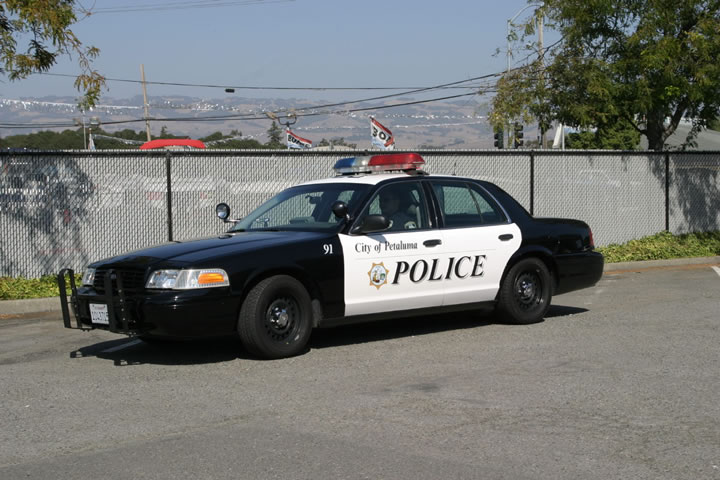
Petaluma Police Department patrol car

This sounds like a lot of people but in reality many of the jobs in the fifth paragraph are staffed by people in the fourth paragraph. While SROs are normally dedicated to assigned schools, they can also be members of the SWAT team and be “called out” for an emergency. The same goes for Hostage Negotiators. Commonly, they are detectives or patrol officers with special schooling. In larger cities, these positions are more likely to be staffed full-time. In some large agencies, top-tier police association (or union) presidents or representatives are dedicated to the position.

What do they do?

The scope of responsibility for city police is to respond to emergencies, record crimes reports and suppress crime. They also serve criminal (not civil) warrants, write tickets, assist in medical and rescue calls.

As a writer, generally you will have a location in mind, fictional or not. Feel free to call a similar jurisdiction nearby to see how it is structured. Most cops are helpful with this kind of information especially when listen to their answers. Cops appreciate that.

Next week

Next week, we will talk about public safety departments, sheriff’s jurisdiction, marshal’s office, state cops, California Highway Patrol and finally the Feds.

Feel free to add anything you might note is different in your locale. Most law enforcement agencies are standardized throughout California.

Categories
More Street Stories Writer's Notes

Off Duty

This past week, I polled some of my law enforcement buddies to find out some “situations” that have arisen in social settings because of their career choice. I’m certain that doctors, accountants, attorneys and others are cornered at cocktail parties for “a little advice.” Everyone has their own way to handle these circumstances; some are processes that evolve over the years.
For instance, my early years in law enforcement were as a Parking Enforcement Officer–yes, a meter maid. Rest assured, I’ve been called everything. But in uniform at the ripe young age of 21-24, I seemed to be fodder for all the jokes: “Hey, lovely Rita…” you know the song, right? Well, I have a sense of humor, dammit. I laughed right along with them…for a while. When it got tiresome, it became one of those things about the job that I had to ignore. We all have our way of coping.

San Rafael PD Meter Maids c1973 Marie Morris, Sharon Bunker, Thonie Mulcahy (Hevron)

Take a coffee break, for instance. Picture this: you’re on patrol, in uniform and you’ve taken three burglary reports already. It’s not even 9am. You scan the calls for service on your mobile digital computer and see that you don’t have any pending calls. It’s time for a coffee break! Fifteen minutes of peace and a good cup of java. You’ve looked forward to this all morning. You find your favorite Starbucks, order your drink (you don’t dare order a donut in public) and find a quiet table in the back. You’re sitting there, sipping and checking your email on your phone, when a “Joe Citizen” from across the room meets your gaze. He smiles, you smile back, and return to your coffee.
Then, “JC” is on his feet, motoring toward you. Your return smile was all the encouragement he needed. “JC” pulls up a chair, plops down and says something like, “I’d like to run something by you and see you what you would do…” And, as they say at the races, he’s off! The story is about a moving ticket he got last month from some quota-hungry, gung-ho cop in the next town over. The details vary from each telling, but the point is the same. He got the ticket and he believes he was wronged. When you politely decline to second-guess Officer Quota Hungry, “JC’s” voice grows a little stronger. You tell him that court is his best remedy–that’s what it’s for. It is his chance to convince the judge the ticket was unmerited. You try to explain all the variables involved in assessing the need for a citation, but “JC” doesn’t want to hear it. He wants an ally and at the moment, you are public property.
You aren’t an ally. You can’t be. If you take up his cause, it will be your name the Judge and Officer Quota Hungry hear in court while “JC” is discounting the merit of the ticket. The Judge will be merely annoyed but Officer Quota Hungry and every other cop in the courtroom will know that you didn’t back a fellow cop. It doesn’t matter if the officer was wrong; it is simply not another cop’s place to subvert his judgment.
And, you’ve burned your 15 minute coffee break.
Relieved that dispatch is calling, you turn aside politely, speak into the mike, then tell “JC” you’ve got a call waiting and have to go.
You make a mental note: next time use the drive-thru and sip your coffee at a local fire station.
Technically, you are on the clock while on a break. As a cop, you are always on duty, but particularly while in uniform on patrol, you are subject to being called for any urgent situation.
Another point that needs to be made here is cops bad-mouth other cops regularly–often directly to their face. It is part of the life: you have to be tough-skinned not only for the public but your peers. However, the unwritten rule is, no one, especially “Joe Citizen” can talk trash about another man (or woman) in blue. It’s part of the “brotherhood” mentality which is pervasive, even necessary, in law enforcement. It says, we are all in this together and we have to stick together.
As with everything, there are variations and exceptions, the above is general. When you are reading or writing about a police officer, there are inherent standards of conduct that aren’t written down anywhere. We just “learn” them by modeling, paying attention and listening to the old farts.
Part 2 of this post next week.