Friday and Saturday nights in Hollywood rock, so I made
every effort to be outside as the Watch Commander or assistant W/C. At the
time, the clubs on Vine north of Hollywood Boulevard were some of our problem
bars/clubs. Usually, if we anticipated trouble, we’d stop a cruiser or two in
the center turn lanes of Vine Street just north of Hollywood Boulevard. The
area was known for attracting opposing “groups,” so this location was a good
place to be.
One summer night two officers and I had our units stationed
in the middle of the street when a fight between four men broke out in a club parking
lot. Officer Manny and I took off for the fight as his partner got on the radio
requesting back-up. While running I pulled my collapsible baton from its
holder, snapping it back to let gravity do its work. I got to where two of the
combatants were on the ground and yelled, “police, break it up!”
The men kept fighting so I struck the guy who was on top and
he fell to the ground holding his right shoulder. The guy on the bottom took
off, so I concentrated on the guy on the ground. Knowing Manny was behind me I
holstered the baton and began handcuffing the guy.
Just then I heard Manny say, “Sarge, we need to talk after
you finish.”
After I got my arrestee handcuffed, I looked up at Manny and
saw that he was bleeding from the top of his forehead. “What the hell happened
Manny!?”
“I was running behind you when you struck me with your baton,
Sarge. I fell to the ground and damn near passed out.”
Oh crap, this was not good!
Arriving back-up located all four guys thanks to witnesses
and I transported Manny to the hospital. I cracked his head pretty good and he
required some stitches. Manny was put off work for a few days. I was working
the Watch Commander’s position when I got a call from Manny telling me that he
was at the hospital obtaining a back to work release. I sent a field sergeant
to meet Manny and complete the paper work. The sergeant phoned me and said that
Manny was with his mother and added that they were enroute to the station.
When Manny and his mother walked into the office, I
immediately apologized to the man. I said, “Manny, let me buy you a bottle of
your favorite Tequila.”
Manny said, “Don’t drink, Sarge.’”
But before I could respond his mother said, “Tequila es
bueno.” Well, at least she wasn’t angry
with me.
TRAFFIC COURT
It was New Years day, 2004 and I was on patrol west bound on
Hollywood Boulevard when I observed a rather portly man at Cherokee Avenue
standing outside the crosswalk half way into the street. He was leaning on a
cane, totally ignoring the cars that had to go around him to avoid hitting him.
I stopped, exited my cruiser and approached the man. “Sir,
are you okay?”
“What do you want,” was his reply.
“Can I help you back onto the side walk?”
“I’m fine right where I’m at!”
This back and forth went on until I felt that the gentleman
was not about to move. I asked for a unit to meet me. When they arrived the
three of us escorted the “protesting” and angry man to the side walk. The guy
had not been drinking but his attitude was terrible. Now, I have never been a
ticket writer, but this guy needed to start the New Year off with an attitude
adjustment. I borrowed one of the officer’s citation book and I issued the man
a citation for “pedestrian in the roadway.”
Several months later I received a subpoena for traffic
court. Yup, my Hollywood and Cherokee guy, Mr. Smith. So here we are, in
traffic court. Mr. Smith is helped up to his podium by two men, maybe his sons.
I’m standing at my podium as the judge tells Mr. Smith he can tell his side of
the story. Smith jumps into a story of bad cop nothing better to do, harassment,
didn’t happen, crippled, on and on. After Smith completed his tirate speech the
judge looked at me.
“Sergeant Diaz, do sergeants usually issue traffic
citations?”
“No, your honor”
“How long have you been with the department, Sergeant?”
“Over 30 years, your honor”
The judge looked at Mr. Smith and stated the following, (he did because I was there……..) “Mr. Smith, we are about ready to put this man out to pasture. Something happened out there that made the Sergeant get out of his police car. Something you caused.”
From Thonie: Dave Freedland is a colleague and friend who’s written two police procedural thrillers. This is a great opportunity to meet a law enforcement leader and author.
Retired Irvine Deputy Chief of Police, Dave Freedland, will be discussing his new book next week, Thursday, January 17th, at the Huntington Beach library. “The Pepper Tree” will be out soon when the cover art is finished, and the book launch date and location will be announced in the coming weeks.
Like cops, firefighters apparently get bored, too. Sometimes,
boredom turns into pranks. There once was an LA City fire station in South LA
manned by firefighters who liked to “bomb” police officers who were making
traffic stops nearby.
LAPD Air ship
It all started one day when some officers reported
that they were being pelted by water balloons from an unknown source. Hearing
this on the police radio, and it being an unusual call, Air-3, a police
helicopter crew, flew to the scene hoping to assist in spotting the origin of
the “aerial attack.” The air crew knew that there had been prior reports of
this strange occurrence from previous roll call briefings.
Arriving overhead, the only uncommon activity the
‘copter crew observed was some firefighters standing on top of their fire house
and waving with big, sheepish grins on their faces. Thinking that it was
unusual for the firefighters to be up on their roof, it could only be imagined
that these were the culprits. Other than that, the source of the water balloons
could not be found. The air crew decided to fly away but radioed to another ground
unit to park nearby and watch for any suspicious activity that might be coming
from the fire station roof.
It wasn’t but a few minutes later that water balloons
were observed being catapulted over the parapet of the fire house roof. Again
Air-3 flew back over the scene and once again saw that the firefighters were
standing and waving innocently. They didn’t know that they had been caught in
the act.
Apparently, the firefighters had rigged-up some
surgical tubing and made a huge sling-shot. For self-amusement, they would
assemble water balloons and take them to the roof. There they would watch for
police cars to stop within a block or two of the station. At that time, and
hidden from view, they would commence their airborne assault. Now discovered by
Air-3, the “air war” was on. It would be time for “payback,” LAPD vs. LAFD.
A few weeks later, it snowed on some of the higher
mountains surrounding Los Angeles. The Air-3 crew decided it was time for
payback. Sneaking a small, Styrofoam picnic cooler onboard, the crew of Air-3
flew up to the hills in the northwest part of Devonshire Division; landing on
the helipad of an abandoned Nike missile site where it had snowed. The observer
exited the ‘copter and quickly packed several snowballs, placing them in the
cooler. Then Air-3 flew down to the fire station hoping that the “fire perps”
would be outside. And, as luck would have it, they were; washing and polishing
their beloved fire truck.
As Air-3 circled overhead, the pilot and observer
waved, only this time, they were the ones with sheepish grins. When the
firefighters went back to their task of cleaning, several snowballs came out of
the sky, sending the firefighters scurrying for cover. As some snowballs
pummeled the fire truck, a few of the firefighters waved back, only this time
with one finger. The pilot came on the PA and yelled down, “For the Water
Balloons…SNOW HAPPENS!”
A few days later, a photograph was received in the
mail at Air Support’s heliport marked with “Attention to Air-3.” In it was a
single picture without words. It depicted an LA City fire helicopter dropping
its load of water … all 360 gallons. Thus, an undeclared truce was immediately
put into effect.
Public safety workers — police, fire fighters, EMTs
— face emergencies daily. They must go home with headaches lots of days.
However, one problem that few have faced (except in practice drills) is solving
problems after the Model State Emergency Health Powers Act has
been invoked.
This law allows states to invoke legally
enforceable quarantines to control epidemics and to respond to acts of
bioterrorism. This legal quarantine would only be invoked in the U.S. when
there are no effective treatments or preventative measures, e.g. vaccines, for
a contagious disease or organism released by a bioterror attack.
Basically, the rights of a few individuals are
lost (They’re isolated.) to protect the larger population. Pretty scary and a real headache
for public safety workers. They can’t enter the isolated area (except with
extensive gear) unless they’re willing to be isolated, too. Thus, I thought a
quarantine was the perfect situation for my new novel — The Flu Is Coming.
In The Flu Is Coming, a new type of flu
— the Philippine flu — kills nearly half of the residents in an upscale, gated community in less than a week.
A quarantine is invoked. It makes those who survive virtual prisoners in their
homes. The Centers for
Disease Control (CDC) recruits Sara Almquist, a resident of the community, to
apply her skills as an epidemiologist to find ways to limit the spread of the
epidemic. As she pries into her neighbors’ lives, she finds promising
scientific clues but unfortunately, she also identifies the criminal past of
several of her neighbors. Violence erupts when they try to escape the
quarantine.
The Flu Is Coming has an exciting plot and sympathetic and
villainous characters. It will also make you think about the limits of modern
medicine and what can occur when those limits are reached. Why not read it now
during flu season?
Bio: J.L. Greger is a
scientist and research administrator turned novelist. She likes to include
tidbits of science in her award-winning thriller/mystery novels:Murder:
A Way to Lose, Riddled with Clues, and others. To
learn more, visit http://www.jlgreger.com
New Year’s Eve: I was one of eight uniformed Metro officers who along with a sergeant was assigned to Hollywood and Vine. I have never been good at estimating crowd size. I just know we are packed solid on all four corners.
The crowd was
in various stages of drunkenness but generally well behaved. It consisted
mostly of people who by now were probably tired of standing, wondering why they
are here, asking themselves when they are going to start having fun but most of
all, where’s then nearest rest room? Needed soon.
In the
center of the intersection was a man hole cover. Custom and tradition said, to
stand upon said manhole cover exactly at midnight would mean what?
It was sort
of a “king of the hill” thing.
Vehicular
traffic had been moving at a snail’s pace but was now shut down and diverted
off the boulevard.
On his bull
horn, the sergeant tells the crowd that it is 11:55 and they can have the
intersection for 10 minutes.
The crowd
who had been standing numbly on the sidewalk is now in the street thinking the
same thoughts as before. But for a few this may very well be the most exciting
or daring thing they have ever done in their lives.
Some can
probably see their obituary: “The deceased Mr. Beanie Watros, in addition to
his 40 year service as assistant manager at the Widget Factory, was somewhat of
a local legend having on one occasion actually stood in the center of
Hollywood and Vine at the stroke of midnight on New Year’s Eve until rudely
pushed to the curb by a large police officer with a stick.”
The sergeant
begins the countdown……one minute………30 seconds……..10-9-8…….
Hollywood and Vine in the daytime.
Now the
attempt to “take” the manhole begins.
There are
always 8 or 10 ready to do battle.
Now, we have
two types of fighters—those who fight like 12-year-old girls (sorry ladies) and
those who learned from watching silent movies where everyone “swung
roundhouse punches arms fully extended.” If they connected, everyone went
down.
Miss and
they went down.
At 12:05 the
sergeant’s whistle tells us to take the street back. We commandeer the “standing”
drunks to move the “down” drunks to the sidewalk.
“But officer,
I don’t even know this guy.”
“Neither do I
friend. Now put him over there.”
The crowd is
now back where they started wondering, “what just happened?”
“Did I have
fun or what?”
They mill
about for a bit until someone comes up with the best suggestion of the night.
“Come on. Let’s get out of here.”
Not to long after we are released so we can drive to Pasadena and work the Rose Parade for the princely sum of $25.00.
As it’s already January 4th, I’ll bet you’re
getting pretty tired of “the year in review,” “turn a new leaf” style posts. I
can only hope this one will be different. I’m not going to impart any organizational
wisdom, teach you a new mystical path to follow or suggest that, in any way, I
know something that you don’t.
The thing is: you already know what you need to do be a better
you-financially, professionally, spiritually, and physically. You just need to
do it. No excuses. If now really isn’t the time, schedule it for later. But
schedule it.
2018 was the worst year of my life. I’ve heard that from many others, too. 2019 is more promising but some lingering issues are already casting shadows over my bright shiny new year. To add a note of optimism, the mister and I have several exciting trips planned this year–a wonderous prospect in itself. This time last year, the only trip we could plan was to the Emergency Department. Things are SO much better today. And, I keep plugging along. One thing I learned from 2018’s trials is wallowing in misery gets me nowhere—fast. Sure, my workload has grown, external pressures push at my patience but isn’t that the way of life? It’s always something—the body doesn’t discern between good and bad stress. Here, I have to thank God for my faith. He is what propels me onward, striving to be better at this human thing.
My Boomer generation bought into an idealism that is, in my
opinion, unattainable, an illusion. It’s caused many of us to become embittered,
maybe even helped foster the divisiveness that separates our great nation. Is
it possible I missed the boat on idealism? I like the beauty of sunset, cute
puppies, and warm, fuzzy moments. In fact, I LOVE all those things. But after
the sunset, comes dark; puppies grow up; and moments are gone in a heartbeat. Utopia
does not exist. Life is not a Magnolia magazine spread. It’s fine and gritty, sweet
and sour, sometimes both at the same time.
Recovering from my self-indulgent moment, I’ve come to realize
that moving forward, keeping after my goal (dream? prize? it is whatever you
want to call it) is the only thing I can do. I can finish that fourth book, I
can get back in the saddle, I can stretch my marketing wings. They may be baby
steps, but I’ll be moving forward. Standing still isn’t for me.
In conclusion, I want to say my purpose is to pat you on the back
for showing up and let you know you’re not in this alone.
Somewhere throughout the land there are probably a handful of
old men who can claim the title connected to this Hollywood icon.
On the east coast in New York City every New Year’s Eve since
1907 the ball has dropped in Times Square. People come from great
distances to be there and be part of the action.
3000 miles to the west however, we have the holy grail of
locations—Hollywood and Vine. Famous the world around. If Hal had a dollar for
every time he drove through this intersection he would have more money than Bill
Gates.
I think I can say without contradiction that Hollywood
has more strange, unusual, weird and bizarre characters than any
place else in the city. If that is not enough thousands more are imported for New
Year’s Eve.
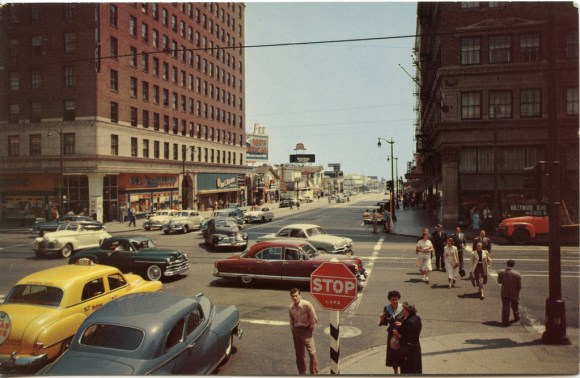
Hollywood and Vine circa 1952
Without having specific instructions, the new comers and maybe
some locals too, are largely engaged as follows:
They are required to drink tremendous amounts of alcohol (mostly
beer), to wander aimlessly in small groups or herds, to argue at the tops of
their lungs with anyone and everyone, to challenge all comers to fight, “You
want a piece of me buddy, come on.”
And then either lose interest or forget what they were doing,
usually throwing up on anyone within range or themselves, and last but not
least to fall down and sometimes fall asleep.
The following is true, so help me. I once saw one of our coppers walking while pulling on a piece of rope, holding on to the rope were 4 or 5 real, real drunks. He said with a straight face that he was taking them to get coffee and if they didn’t have the rope, they would fall down.
There are no elves, nor grinches, no Jacob Marley and no Tiny Tim.This is the tale of one minor incident in the city on any given day.
The Call Box
I was a sergeant working Wilshire Division detectives and with three others were the “Christmas crew.” My hope for a quiet day to work on reports evaporated when a patrol officer called in a “DB” (dead body) call at the far west end of the division, the high rent area.
Homes were well-tended and pricey. I was met by the uniformand the neighbor who is a “Spring Byington” look-alike, both in looks andmannerisms. “Spring” came over to wish Merry Christmas to her friend Abigail. Receiving no answer, she went home and called. Alarmed when there was no reply, she phoned the police.
The uniform had no trouble gaining entry and found Abigail deceased.
Dressed in pajamas, quilted robe, and slippers she was seated in an overstuffed arm chair facing the tree. The remnants of a cocktail sat ona low table to her left.
From all outward appearances she died the night before. After deciding cause of death to be “natural” and thinking that was a pretty good wayof checking out, I released the uniform and turned my attention to “Spring.”
I covered Abigail’s face with a blanket and asked “Spring” about next of kin. She confirmed her friend like herself was in her 80’s and a long-time widow.
Spring Byington in Kentucky Jones 1965
Three grown children, a daughter, Ellen, living in Arizona who she spoke to by phone on a weekly basis, and two sons both estranged, whom Abigail never discussed, names unknown.
Kitchen “wall phones” were popular then and usually had a corkboard or message receptacle adjacent. Abigail did not disappoint. In one corner of the board was “E” with an Arizona number. Directly below was “T” and “D”who I hoped were the sons. Neither E nor T answered nor did a machine.
D answered, “Merry Christmas, this is Dick.” Now the crappy part. Anyone who has ever made a death notification can verify there is just no easy way. I couldn’t blurt out, “Merry Christmas, mom’s dead.” So, in my most diplomatic fashion, I gave him the news as gently as possible.
Now, this is a man who, by his later admission, had not spoken to nor made any inquiry regards his mother’s health or well-being for many years. He completely went to pieces. He was an hour away and would be enroute.
“Spring,” bless her heart, had without prompting nor asking has made a pot of coffee. We sat with our coffee sharing the silence, I finally asked about Abigail’s doctor.
“Spring” had driven her friend to the cardiologist on several occasions. He was on Wilshire and although she could not remember his name it started with “W.”
Abigail came through again when the board yielded Dr W. Department policy stated if a doctor who had seen the deceased within the last thirty days (I think) and was willing to attest to cause of death, he could sign the death certificate. Otherwise it became a coroner’s case.
Dr W’s service stated Dr G was covering for him. I asked Dr G’s
service for a call back a.s.a.p. Ten minutes later, Dr G confirmed his
association with Dr W, knew Abigail and was sure Dr W would sign off.
Thank you.
“Spring” left and when Dick arrived, he cried openly and told me of his regrets. It was awkward and there was nothing I could really say. I was finally able to calm him down enough to call a mortuary. I then walked next door responding to “Spring’s” invitation and enjoyed a very good breakfast.
The names Abigail, Ellen, T and D along with the doctors’ are invented for this story as it was long ago.
When someone mentions the 1950’s we tend to think of a more innocent time, a peaceful and happier period.
Take 1957 for example: Ike was president, The Bridge on the River Kwai won the Academy Awards best picture, the Milwaukee Braves won their first ever World Series, beating the N.Y. Yankees 4 games to 3. The Super Bowl was ten years in the future, the Russians gave us Sputnik, the National Guard enforced school integration in Little Rock, Gunsmoke was number one on TV with Danny Thomas second. Five of the top ten were westerns. Nobody had ever heard of Viet Nam.
And 128 law enforcement officers died in the line of duty. 13or 10% were in California.
This the story of two of them.
The city of El Segundo is south and west of LA. A beach community approximately 5.46 square miles, today about 17,000 residents. The name Segundo is Spanish for second as the city is home to the second Standard Oil Refinery Tank farm.
On a hot summer night, Monday July 22 at 1:30 A.M., El Segundo Patrol Officers Richard Phillips, 28, with 2 years’ service and Milton Curtis, 25, 2 months out of the academy stopped a 1949 Ford for running a red light at Sepulveda and Rosecrans.
Phillips exited the police vehicle while Curtis remained seated. At that time a second patrol unit, Officers Charles Porter and James Gilbert slowed to observe. Phillips gave the “ok” signal and they moved on.
A few moments later the motorist produced a 9 shot Harrington and Richardson .22 revolver and shot each officer three times.
Harrington & Richardson
Curtis died instantly. Phillips, considered the best shot on the department, though mortally wounded, emptied his 6-shot revolver at the fleeing vehicle. He put out a help call bringing Porter and Gilbert first to the scene.
Phillips was transported to a local hospital where he succumbed to his wounds as police units from surrounding communities responded and hundreds of officers took up the search.
The unoccupied car was found four blocks away. One item of note was that three of Phillips’ rounds struck the vehicle but only two were found, leading detectives to believe the missing round struck the suspect.
El Segundo PD Officer Richard Phillips EOW July 22, 1957
Off-duty sheriff’s deputies from Firestone Station arrived and set up a perimeter. The search continued throughout the night and the day intothe next night. He was gone.
El Segundo PD Officer Milton Curtis EOW July 22, 1957
What Phillips and Curtis had no way of knowing was that an hour or so prior to the stop the shooter had approached two teen aged couples in the “Lovers Lane” area in the small neighboring community of Hawthorne. Brandishing a revolver, he robbed the group, forced them to strip, bound them with adhesive tape and raped one of the girls, before stealing their ‘49Ford.
What Phillips and Curtis had no way of knowing was that an hour or so prior to the stop the shooter had approached two teen aged couples in the “Lovers Lane” area in the small neighboring community of Hawthorne. Brandishing a revolver, he robbed the group, forced them to strip, bound them with adhesive tape and raped one of the girls, before stealing their ‘49Ford.
They later provided descriptions to profile the shooter indicating he had spent a lot of time with them, was very polite and had a southern accent.
The El Segundo traffic stop was only a short time after the robbery/rape and the victims had not yet freed themselves. The traffic stop turned out to be anything but routine.
Two partial prints (both left thumb) were obtained from the Ford, however this was 1957 and unless they had something to compare them to, they had nothing. L.A. Sheriff’s Homicide took over and the agency with an excellent reputation for closing cases began what was to become a decades long search.
THE HUNT
Many, many interviews, suspects printed, interrogated and released. They chased tips, leads and hunches, all to no avail. Finally, it went “cold” but they did not quit. You do not walk away from this.
In those days’ DNA stood for “does not apply.” Fingerprint searches were done by hand; there were no computers. And still they carried on.
FBI fingerprint analysis
THE FIRST BREAK
In September 1960, just a little over three years after the murders, a resident of 33rd Street in neighboring Manhattan Beach found a rusted .22 revolver in his backyard along with a woman’s watch. In poor condition when tested for ballistics, the gun could only be listed as consistent with the murder weapon. The find was about one mile from where the Ford was located. It was assumed the suspect threw them as he ran. The watches (a search turned up number two) were identified as belonging to the robbery victims.
Now, finally, the detectives had a physical piece of evidence. Something tangible, something to look at, something to hold and better yet something with a serial number.
The Harrington & Richardson model gun had been purchased at a Sears store in Shreveport, Louisiana in June, one month beforethe shooting. The clerk Billy Gene Clark, who was 18 at the time of the sale, was found and interviewed. He remembered the transaction and stated the buyer wanted the cheapest model available $29.95 for “protection.” He liked the composite drawing (from the robbery victims) and provided the paperwork wherein the buyer had signed as G.D. WILSON. Checking other business in the area they found a GEORGE D. WILSON had spent the night at the YMCA. The handwriting looked similar to the Sears receipt.
Over the next few years detectives found and cleared every George D. Wilson in the United States.
What looked like a closer was now just another tempting clue gone cold.
Throughout the 1960’s, 70’s, 80’s and 90’s a succession of detectives plodded on, following leads, tips and just plain hunches. Nothing. During this period over 1000 people were fingerprinted and eliminated and in excess of 2100 “looked at” and cleared.
In the wake of the 9/11 terrorist attacks the FBI revised their fingerprint data base to include thousands of prints from various departments of unsolved crimes, however the base went only to 1980. Not 1957.
THE END GAME
In September 2002 (45 years after the shooting), LASO Homicide Detectives Kevin Lowe and Dan Macelderry who were then responsible for the file took a call from a woman who had overheard a man bragging he was the shooter. His prints were obtained, and he was eliminated. As they were reviewing the file they decided to have the partial prints digitally enhanced using technology not previously available. The prints were then entered into the FBI data base and within minutes—they had a hit!
I can only imagine what those detectives felt at that moment.
In 1956, Gerald Mason age 22, had been arrested and printed for burglary charges in Columbia, South Carolina. Released in 1957, he hitchhiked to California. The gun purchase in Louisiana and the southern accent described by the robbery/rape victims now made sense.
The prints were a gift from heaven, but the detectives knew the D.A.would want more. Over the next four months samples of his handwriting were obtained and proved a match. His 1956 mug shot was ID by the victims, the second radio car (Porter and Gilbert) who drove by just before the shooting and the clerk at Sears.
They built their case slowly and meticulously and in late January 2003, Mason was placed under surveillance for a full week. On January 30, 2003, a phalanx of officers descended on Mr. Mason and his worst nightmare became reality.
When he fled the scene of the shooting, he made his way home to South Carolina where he lived a quiet life never coming to the attention of the authorities. Not so much as a parking ticket. He became a successful businessman owning a string of gas stations before his retirement. He was living the good life, husband, father, grandfather, respected member of the community. Now his home was filled with police officers and when El Segundo was mentioned, he stated, “You are here for that?”
His back still bore the scar of Phillips bullet which had marked him for ID so many years ago.
When confronted about the rape/robbery he stated he was drunk and did not want to remember it. He admitted the shooting, “I had to get thembefore they got me.”
Mason’s friends and relatives were convinced the police had the wrong man. Don’t we always?
He pleaded guilty to two counts of murder on March 24, less than two months after his arrest. He was sentenced to two consecutive life terms, to be served in a South Carolina Prison as part of the plea deal.
He died on January 22, 2017, 4 days before his 83rd birthday.
In 1957 I was a brand-new officer working a radio car and learning how to be a policeman. I carried the wanted notice for the killer until it fell apart.
Over the years I sometimes wondered when and how it would besolved. A fluke and some luck, no doubt. How about both? A five and dime burglary puts his prints on file. A loud mouth in California boasts of being the shooter which brings out the file which updates the prints which gets the hit. Life can be capricious as we know.
This column/blog is written for several different reasons. For those of you too young to remember this, those who knew some but not all and to make sure we don’t forget.
This is also dedicated to those brave men and women who wear or have worn the badge while doing a thankless task for a sometimes unknowing and uncaring public.
Those who have never, helped, or bled or cried for a stranger do not have the faintest clue what it is like to be a police officer.
I observed an altercation last week in the seafood department at Safeway. The argument was over freshness. An irate and intoxicated customer threw a large chunk of Atlantic Salmon at the seafood manager and hit him in the face. A bloody nose was the result.
Being a retired law enforcement officer, I stepped in and made a citizen’s arrest. I told the customer he was being arrested for Assault with a Dead Weapon.
When the police arrived, they complimented me on my creativity, but just charged the man with Battery and Drunk in Public.
Jim Hasse’s Bio: I had a 28-year law enforcement career. I worked as a deputy sheriff and a detective in Madison County, Illinois, early in my career, but served as a U. S. Postal Inspector for 20 years, retiring in 1998. The short answer is: Jim Hasse, retired U. S. Postal Inspector from Walnut Creek, CA.