Categories
More Street Stories

For a Fallen Officer

Fallen Hero
Fallen Hero Officer Kenyon Youngstrom. EOW September 5, 2012. Our thoughts and prayers go out his family and his co-workers during this difficult time.
This was posted on Facebook by a friend of mine-a retired city cop. No matter what your jurisdiction, the death of a law enforcement officer affects the entire community.
Felt like I needed to post this for others to read. It’s a post from a blog called MotorCop. Brings everything home!!!!

11-99.”

“Officer down.”

If you’re in law enforcement, you know what these terms mean. You know the chill it sends down your spine. You can feel the adrenaline dump surging through your body. You have felt the extraneous drift away and the focus settle on you. Your throat tightens. Your senses sharpen.

Today, I felt all of those things.

As I literally walked away from morning coffee, I heard an officer on the air ask dispatch to confirm an officer called 11-99 and then put the location out. I didn’t wait for confirmation. I got on the bike and responded.

Because that’s what we do.

When I arrived on scene, life saving measures were being performed on an officer that had been the victim of a gun shot wound. Other officers were yelling the victim officer’s name. Encouraging him to fight. To stay strong. To stay alive.

When Fire arrived and the victim officer was put on a backboard, my eyes focused on his left hand. Specifically, the gold band around his ring finger.

Shit.

When it came time to put the backboard on a gurney, I held that same hand. I wasn’t in the way, but I certainly wasn’t a key component to his transport from the road to the ambulance. But it was important to me. I don’t really know why.

I spent the majority of my day at the hospital. I tried to help where I could. I tried to have a servant’s heart. I shuttled more people from the ER to an auditorium than I can count. I prayed with the officer that was the victim officer’s backup. I took photos and collected evidence. I wasn’t the only one there by any stretch of the imagination. Officers from multiple jurisdictions were both on scene and at the hospital pitching in and doing what they could to help.

Because that’s what we do.

When all was said and done, I came home to my beautiful Wife and three MClets. Holding my bride and seeing my kids smile defies cognitive description. Yet, I can’t help but think about the victim officer and his family.

I didn’t get hurt today. I showed up to do what I could for another officer I’ve never met as did dozens of others from across the county. Circumstance led me to be in a position to be up close and personal with the aftermath of today’s shooting. Consequently, I’ve received multiple calls, texts, and messages from fellow officers asking me how I’m doing.

How I’m doing?

This is one of the many things I love about my chosen career. It’s this kind of caring for another person that is invasive and prototypical when the rubber meets the road. I work with some of the most incredible men and women.

This is what cops do, my friends. We aren’t just there when it hits the fan. We are there for each other over the long haul. I am proud to be a cop. I’m proud of the men and women I serve with.

When we are so close to tragedy, be it on the periphery or directly involved, it affects us. We may not know it. It may manifest in different ways for different people. I learned a long time ago from growing up in a civil service family that bottling emotion doesn’t do any good. It’s imperative to talk with someone.

I’m lucky enough to have a veritable multitude of people to rely on. First and foremost, I’ve got God. A close second is the Wife. Both of my folks have been privy to many a tale. Finally, there’s you.

Yes, you.

You are part of my catharsis. When I posted on Facebook and tweeted, “I need immediate prayer for a CHP officer shot,” I was inundated with supportive responses. LEOs and First Responders don’t always have time to deal with their emotions when it’s convenient. It’s all about compartmentalizing and getting the job done. I said to myself numerous times today, “Not time yet” when I felt the tears well up. The job wasn’t done.

Now, my part of the job is done for today. I cried when I walked in my home to the Wife’s loving embrace. I made calls that needed to be made and checked on my partners that needed checking on. I sat down to write this post to exorcise the demons of hatred, animosity, confusion and rage.

I’ve already thanked the specific people in my life directly, but I wanted to reach out to you to let you know you aren’t just reading this silly little blog and getting the occasional chuckle. You have impacted me. You have propped me up when I needed support.

Please continue to keep all the involved officers in your prayers as well as their families and co-workers. The California Highway Patrol and surrounding jurisdictions are already back on duty keeping a watchful eye out for you. To protect you. To serve you.

Because that’s what we do.

Categories
More Street Stories Writer's Notes

More jurisdictional lines…

Sheriff’s departments–at least in California–are charged with criminal, contract, correctional and civil matters. In addition to performing law enforcement duties, they must serve eviction notices, bank and property levies, and small claims. They also staff court security as well as county jails. Some counties, like Marin, require their deputies to work in the jail before being assigned to patrol. Deputies I’ve talked to about this have mixed reviews. Some like knowing who the criminals are before they get in a patrol car. Others don’t want to be confined all day themselves. There are the counties, like Sonoma, which is staffed by classified employees called “correctional officers”. Unless they test for deputy, they will spend their entire careers in the jail.

Even before the economy tanked, municipalities found themselves in fiscal trouble. Police protection is expensive for many reasons, not the least of which is that it must provide 24/7 service. In the past two decades, Sonoma County has provided contract police services with two cities-Windsor and, most recently, Sonoma. They serve in the same capacity as a municipal department but because of their resources, can often do it cheaper. Marin County Sheriff’s Department has taken over almost all police and fire dispatching.

Deputies in rural areas such as Mono County are called upon for coroner duties. Specific certification is required before assuming those responsibilities. Please note the difference here between a Coroner and a Medical Examiner. Often, a coroner is a deputy or an elected official and is mostly found in rural areas, while a medical examiner is at minimum a medical doctor, hopefully with a background in forensic pathology. Metropolitan areas can generate funding to support this pricey level of expertise, while boondocks agencies and thinner population bases cannot. If you write a story that involves a death-anywhere-it’s best to check a similar jurisdiction to see what kind of system they have. Nothing can shoot your credibility in the foot like a “local” medical examiner in the middle of Death Valley. FYI-Death Valley has one of the highest suicide statistics in the country-just because of its name. People travel from all over the US to do themselves in at Zabriske Point. Inyo County Sheriff patrols that area but relies on out of the area ME’s-such as Las Vegas, Nevada.

Redwoods
Trees on Sonoma County hill during helicopter recon for marijuana

Back to Sheriff’s Departments: Deputies are a different breed from city cops–as any city cop will tell you! They do things by their own rules, maybe even tending toward aggressiveness. I think there is a reasonable explanation for this. When I worked for Sonoma County SO, I knew that the logistics for patrolling 1,769 square miles (minus the 7 incorporated cities who have their own departments) with about 275 deputies (never all on at the same time) would be cause for delay if more units were needed. I often saw back-up cars with an eta of 30 plus minutes. Any deputy in a hot situation would need to be a bit of a “cowboy” to survive. If you cannot, you don’t belong in a patrol car on the Sonoma Coast or in the remote hills of the Geysers or the multitude of vineyards. If you want some interesting reading, check out the history tab of the Sonoma County Sheriff’s Department. Many stories, there!

This is one of the reasons I chose Sonoma County Sheriff’s Department as the setting for my first book. These are tough people who use the ingenuity that God gave them, sometimes with force.

They get the job done.

Next week, we’ll talk about Public Safety Departments, California Highway Patrol, State Police, the Marshal’s office and more.

Categories
More Street Stories Writer's Notes

Jurisdiction and Jobs

Jurisdictions and Jobs

Police car light bar code 3
police car

I was in a critique group years ago with a writer who had San Francisco PD (SFPD) detectives investigating homicides, a rape and several assaults that occurred in Marin County. The manuscript was completed and the author was using our group to improve the editing. As gently as I could, I explained jurisdiction: SFPD wouldn’t routinely respond to a crime that occurred in another county. There are times when it could happen: mutual aid request from Marin County Sheriff (who handles that jurisdiction) or the crimes are related to an SFPD case. But, normally this is a mistake that could cost the author his readership–at least, readers who know about the cop life. Believe me, there are a lot of us!

It was unfortunate that he chose to dump an otherwise very entertaining story. But, to varying degrees, I see the same type of mistake in almost every book I read, certainly every cop show on TV and most movies. As much as I love Donny Wahlberg and Tom Selleck, I had to turn off Blue Bloods for this reason. When I see cop characters interfering where they would never go, saying things that are inconsistent with the cop culture or other inaccuracy, it is so distracting that I lose track of what is going on.

Okay, how does jurisdiction work?

With this in mind, I thought I’d spend some time explaining the roles of each type of law enforcement officer and their jurisdictions and responsibilities.

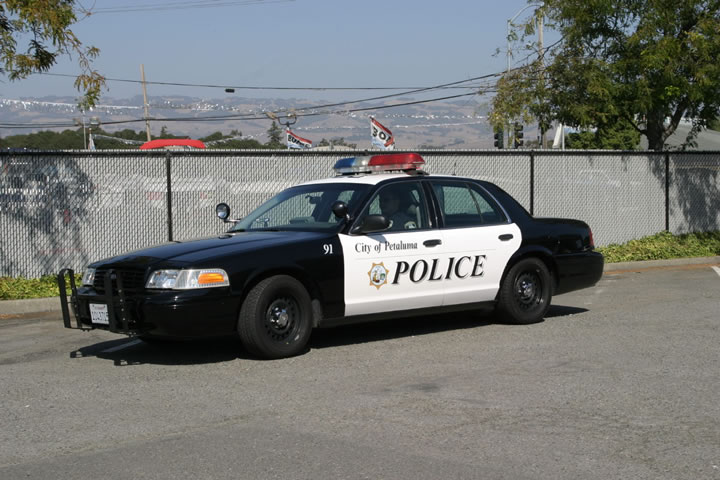
We will start small with the city police. It is the basic unit of the law enforcement fabric. Take a city–Petaluma, California, for instance. The 2010 census tallied the population at 57,941 for an area of nearly 14 square miles. The police department is structured like this (source Petaluma Police Department website): 94 full-time employees, including the Chief, two Captains, three Lieutenants, ten Sergeants, fifty-two Officers, twelve Dispatchers, four Community Service Officers, two Parking Enforcement Officers, and other support staff. Additionally, the Department has D.A.R.E. Officers, two School Resource Officers (SROs), an Explorer’s Program, a Traffic Unit with a Serious Traffic Offender Program (S.T.O.P.), a K-9 Unit, Bicycle and Motorcycle Patrol, Dual Purpose Motorcycle Unit, a SWAT Team, a Hostage Negotiation Team, Patrol Gang Enforcement, an Investigation Unit, and a volunteer Reserve Community Service Officer Program.

Petaluma Police Department patrol car

This sounds like a lot of people but in reality many of the jobs in the fifth paragraph are staffed by people in the fourth paragraph. While SROs are normally dedicated to assigned schools, they can also be members of the SWAT team and be “called out” for an emergency. The same goes for Hostage Negotiators. Commonly, they are detectives or patrol officers with special schooling. In larger cities, these positions are more likely to be staffed full-time. In some large agencies, top-tier police association (or union) presidents or representatives are dedicated to the position.

What do they do?

The scope of responsibility for city police is to respond to emergencies, record crimes reports and suppress crime. They also serve criminal (not civil) warrants, write tickets, assist in medical and rescue calls.

As a writer, generally you will have a location in mind, fictional or not. Feel free to call a similar jurisdiction nearby to see how it is structured. Most cops are helpful with this kind of information especially when listen to their answers. Cops appreciate that.

Next week

Next week, we will talk about public safety departments, sheriff’s jurisdiction, marshal’s office, state cops, California Highway Patrol and finally the Feds.

Feel free to add anything you might note is different in your locale. Most law enforcement agencies are standardized throughout California.

Categories
More Street Stories Writer's Notes

More off-duty

Cops, by nature, want to help. Sometimes that drive can cause unforeseen problems.

Last year, Marin County Sheriff’s Deputy Jim Mathiesen was killed while trying to help out a friend of the family. The circumstances are beyond tragic. Mathiesen was off duty when he received a call from a friend who received death threats from an ex-boyfriend. The ex showed up shortly after Mathiesen arrived and killed the unarmed deputy. The link to the news story: http://www.sfgate.com/bayarea/article/Off-duty-Marin-deputy-killed-trying-to-help-friend-2353962.php#next   

It’s common knowledge that domestic disputes are the most volatile of all calls for service. Whether you know the involved parties is irrelevant. Officer Vilho Ahola of Petaluma (California) Police Department  could attest to this–if he was alive. On November 7, 1969, he responded to a domestic between a couple he called friends. He was shot in the neck and rendered a quadriplegic until in death in 1998. Read his story on the Officer Down Memorial Page: http://www.odmp.org/agency/3091-petaluma-police-department-california

Back to how civilians react to cops in social situations. At parties that aren’t “cop parties”, most law enforcement people I know, offer another profession when asked. I’ve heard cops call themselves trash collectors, personnel specialists and even rocket scientists. This is to avoid the coffee shop scenario described above.

It has been many years since I dated (thankfully!) but the last thing I want to deal with on a blind date is intrusive questions about what I do for a living. Some people are scared off by law enforcement (ya gotta wonder what they’re hiding!), some are fascinated by it–that’s another post altogether–and some have pre-conceived ideas about the cop personality that don’t allow the freedom to enjoy a new relationship.

I’ll conclude this post with a promise to address more “cop talk” issues for the reader and the writer next week. As always, please feel free to ask questions. I’ll do my best to answer.

Categories
More Street Stories Writer's Notes

Off Duty

This past week, I polled some of my law enforcement buddies to find out some “situations” that have arisen in social settings because of their career choice. I’m certain that doctors, accountants, attorneys and others are cornered at cocktail parties for “a little advice.” Everyone has their own way to handle these circumstances; some are processes that evolve over the years.
For instance, my early years in law enforcement were as a Parking Enforcement Officer–yes, a meter maid. Rest assured, I’ve been called everything. But in uniform at the ripe young age of 21-24, I seemed to be fodder for all the jokes: “Hey, lovely Rita…” you know the song, right? Well, I have a sense of humor, dammit. I laughed right along with them…for a while. When it got tiresome, it became one of those things about the job that I had to ignore. We all have our way of coping.

San Rafael PD Meter Maids c1973 Marie Morris, Sharon Bunker, Thonie Mulcahy (Hevron)

Take a coffee break, for instance. Picture this: you’re on patrol, in uniform and you’ve taken three burglary reports already. It’s not even 9am. You scan the calls for service on your mobile digital computer and see that you don’t have any pending calls. It’s time for a coffee break! Fifteen minutes of peace and a good cup of java. You’ve looked forward to this all morning. You find your favorite Starbucks, order your drink (you don’t dare order a donut in public) and find a quiet table in the back. You’re sitting there, sipping and checking your email on your phone, when a “Joe Citizen” from across the room meets your gaze. He smiles, you smile back, and return to your coffee.
Then, “JC” is on his feet, motoring toward you. Your return smile was all the encouragement he needed. “JC” pulls up a chair, plops down and says something like, “I’d like to run something by you and see you what you would do…” And, as they say at the races, he’s off! The story is about a moving ticket he got last month from some quota-hungry, gung-ho cop in the next town over. The details vary from each telling, but the point is the same. He got the ticket and he believes he was wronged. When you politely decline to second-guess Officer Quota Hungry, “JC’s” voice grows a little stronger. You tell him that court is his best remedy–that’s what it’s for. It is his chance to convince the judge the ticket was unmerited. You try to explain all the variables involved in assessing the need for a citation, but “JC” doesn’t want to hear it. He wants an ally and at the moment, you are public property.
You aren’t an ally. You can’t be. If you take up his cause, it will be your name the Judge and Officer Quota Hungry hear in court while “JC” is discounting the merit of the ticket. The Judge will be merely annoyed but Officer Quota Hungry and every other cop in the courtroom will know that you didn’t back a fellow cop. It doesn’t matter if the officer was wrong; it is simply not another cop’s place to subvert his judgment.
And, you’ve burned your 15 minute coffee break.
Relieved that dispatch is calling, you turn aside politely, speak into the mike, then tell “JC” you’ve got a call waiting and have to go.
You make a mental note: next time use the drive-thru and sip your coffee at a local fire station.
Technically, you are on the clock while on a break. As a cop, you are always on duty, but particularly while in uniform on patrol, you are subject to being called for any urgent situation.
Another point that needs to be made here is cops bad-mouth other cops regularly–often directly to their face. It is part of the life: you have to be tough-skinned not only for the public but your peers. However, the unwritten rule is, no one, especially “Joe Citizen” can talk trash about another man (or woman) in blue. It’s part of the “brotherhood” mentality which is pervasive, even necessary, in law enforcement. It says, we are all in this together and we have to stick together.
As with everything, there are variations and exceptions, the above is general. When you are reading or writing about a police officer, there are inherent standards of conduct that aren’t written down anywhere. We just “learn” them by modeling, paying attention and listening to the old farts.
Part 2 of this post next week.

Categories
More Street Stories Writer's Notes

Missing Persons, part 2

This week, I began a series of articles giving the real scoop on police life, rules, culture and so on. They are aimed at writers but fans of TV cop shows might also enjoy this blog post.

We began with Missing Persons (MP): capitalized because it is so important in the daily life of cops. If you get a MP call, you are tied up on paper (writing reports), searches, and follow-up for hours. You are also strictly mandated to follow certain protocols, mainly defined by the state but more often refined by your agency. If you want your character to be tied up on a priority call without fists and bullets, this is your baby!

The following are culled from the pages of many policy and procedure manuals throughout the state:

  • California law is specific that children (no matter what motive) under 14 years of age are to be entered in the National Crime Institute Computer (NCIC) within 4 hours of the report being taken.
  • The caller or reporting party is entitled to a prompt report from whatever California law enforcement agency was contacted. Reports are sent “without delay” (according to the Commission on Peace Officer Standards and Training-POST-which does just what it says: it regulates standards and training) to the agency in which the MP lives.
  • Classifications are given by the call-taker and often set the tone for the event. If the dispatcher garners information that leads him/her to believe that the missing person is a “habitual runaway,” the report will be handled in such a way. Of course, information isn’t always given accurately and one must credit officers for critical thinking to be able to determine if something is not as originally represented.
  • Most agencies in the state have a formal procedure written in their policy books to ensure the proper actions are taken and protect them from liability.
  • Next, the officer will respond and assess the risk. This includes runaways (suicidal?), endangered (such as Alzheimer’s’ patients), suspicious circumstances, and parental abduction. Generally, they include FIRST checking the home-especially young children are often found hiding in toy boxes, under their beds or in closets. An officer will respond to the home and check it thoroughly. After making the determination the MP is not there, he/she may call in a sergeant and available patrol officers.
  • Either the officer (now determined to be the “primary” officer–the one responsible for the report–or the sergeant (depending on leadership skills) will initiate a “grid search”. This utilizes a department map of the city or area, divides it into a grid and details officers to search a square. For instance, an east side patrol officer would search North McDowell and East Washington, east to Maria Drive, north to East Madison–on the Petaluma map it would show almost an exact square.
  • Adjoining agencies will often join in the search at the request of the primary (the agency in which the MP lives). By law the local Sheriff’s Department is in charge of large searches outside city limits. In some cases of imminent peril, helicopters, search dogs and mounted Search and Rescue Unit can be deployed if available. Bear in mind, horses are a matter of concern in potential crime scenes due to the inevitability of damage to evidence. However, they can cover a lot of rugged terrain in the back country.
  • The primary officer will concentrate on gathering information such as a physical description (to be broadcast to all units), photos, and contacts with friends or nearby family. Depending on the circumstances, an officer will mobilize for a technical search by taking “scent” items–clothing recently worn by the MP. Also, electronic devices will be examined, if appropriate.
  • As the search progresses, the officer will obtain the child’s dentist’s name and contact information along with a parental release (permission for the dentist to give X-rays and records to the police)or surgeon for skeletal X-rays. If the child is not located within 30 days, this information is coded and entered into NCIC. In the event a body is found, dental records are used to confirm identity.
  • In our scenario above, it would be expected the Tribal Police, the Sheriff’s Department or both would assist in a search.
  • Other tools include “BOL” or “BOLO”–acronyms for “be on the look-out; Amber Alert; FBI; Office of Emergency Services (OES) or a number of civilian missing person agencies who assist law enforcement.

Something else: in past years, fingerprinting kids has become popular. I think it provides an unfortunate sense of protection for parents. Prints are used to confirm identity just as dental records are–on a body. Usually, the body is not alive.

It should be noted that the above procedures are general but based on my experience. I hope this helps you draw your characters more authentically.  Feel free to contact me for questions or comments.

Categories
More Street Stories Writer's Notes

Missing Persons

Let’s start with Missing Persons reports.
First, a disclaimer: I write only of California law, with which I am familiar. If your book is set in another state or special jurisdiction (such as Indian Reservations, Federal Lands such as BLM, Army Corps of Engineers, and Harbors and Airports) for the sake of credibility, consult that agency to answer your specific procedural questions.
When you sketch out your scene, have a few variables in mind. For instance, a mother returns home to find her 9 year-old daughter missing from their house. They’d had an argument before Mom left. Their home borders an Indian Reservation. Mom calls 911 frantically reporting her little girl has run away.
Considerations:
Under California law, there is NO required wait time to make the report. In fact, any police officer, agency is required to take a report from anyone wanting to report someone missing. In the olden days, cops and dispatchers alike had the discretion to take or refuse a report. Especially in the case of a possible runaway, officers were reluctant to take a report because the reporting process is so cumbersome or the missing person (MP) lived in another jurisdiction. It was (and still is) common for these kids to return home, unrepentant or not, making the paperwork and computer work a frustrating waste of time.
However, as sometimes happens with discretion, a “presumed” runaway turned up as a homicide victim. Imagine your indignation if you were the parent of such a child and had been told, “Wait 24 hours, then we’ll take a report,” instead of initiating a search immediately.

Due to the length of this post, I’m only publishing the first part this week. Look for more specific procedures next week. I’ll be posting on Sunday.