
By Ann Parker
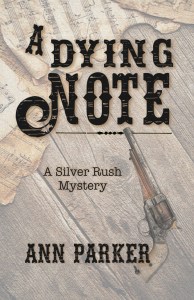 “You will do foolish things, but do them with enthusiasm.” ― Colette
Since April is the month Thonie has asked us to confess those times when we might have lost our minds and all good sense, I had to think hard and go back a ways in time and space.
There was that summer, decades ago, when I rather blithely (and, yes, foolishly) stuck out my thumb and hitchhiked (! solo !) in patched jeans, embroidered workshirt, and “Janis Joplin” style wire-rim glasses through parts of Wyoming. (Truckin’ by The Grateful Dead sums up the gestalt of those long-ago days.) Let’s just say that, since I’m writing about it now, all’s well that ends well… but it could just as easily have all gone sideways on me and very badly at that.
More recently, while conducting research for my Silver Rush historical mystery series, I foolishly ended up in a “tight spot” on a deserted road in Leadville, Colorado. “The Boulevard” appears in early Leadville articles and descriptions—in fact, it’s mentioned several times in an 1880 Daily Chronicle article, quoted here, about Ulysses S. Grant’s visit to town. (You can also find a great photo of The Boulevard by William Henry Jackson on my Pinterest site, here.) However, by the time I went looking for it in 2005 or so, it seemed to have fallen off the map. Honestly, how could a wide, macadam road described as “so smooth that it had nary a straw to impede the wheels of a carriage” disappear so completely? Finally, in an early-version Google Maps satellite image, I spotted the faintest track heading out of town in the right direction through a wooded area.
Determined to set foot—if not wheels—upon The Boulevard, I printed out the grainy blown-up image and drove my little gutless rental car through a church parking lot at the edge of town, looking for a trace. And, by gosh! There it was! A barely visible dirt road.
Or was it a hiking trail?
I hesitated a moment, warnings and legal admonitions from the rental car agreement flashing through my mind. No unpaved roads. Assume all liability. Etc. Etc.
I put the car into gear, eased off the clutch, and pushed on.
I drove that poor little car, shuddering and grinding, down the rubble-strewn more-a-track-than-a-road for maybe a quarter of a mile. The rocks littering the “boulevard” got larger. I slowly negotiated a sweeping curve and, dead ahead, there it was: a huge boulder. Blocking the… well, it was no longer a thoroughfare but more like a path.
That was the end of the road for my yellow rental economy sedan. And there was, alas, no room for turning around. So, I shifted into reverse and backed up the curve and around all the rocks and rubble. I held my breath the entire time until I had completed my retreat to the parking lot.
 Since then, I’ve kept my foolishness limited to impulse buys (! for research !) on eBay. Which is how I’ve managed to amass a modest collection of Victorian trade cards from 1880s for my most recent book in the series, A DYING NOTE. Imprudent, perhaps, but much safer than off-roading or hitchhiking, since the only victim is my wallet.
~~~

About Ann
Ann Parker authors the award-winning Silver Rush historical mystery series published by Poisoned Pen Press. The newest, A DYING NOTE, brings her protagonist Inez Stannert to Victorian San Francisco, California. During the day, Ann wrangles words for a living as a science editor/writer and marketing communications specialist (which is basically a fancy term for “editor/writer”). Her midnight hours are devoted to scribbling fiction. Visit annparker.net for more information. You can also find Ann on Facebook, Twitter, and muddling around on her Pinterest boards.
A DYING NOTE is available in paper and e-book—find buy options here


 Scott Decker, PhD, began as an FBI Special Agent on the streets of Boston, pursuing bank and armored car robbers. Following September 11, 2001 he transferred to counterterrorism, and investigated the country’s first lethal bioterrorism attack. In 2009, he was awarded the FBI Director’s Award for Outstanding Scientific Advancement. His first non-fiction book, Recounting the Anthrax Attacks: Terror, the Amerithrax Task Force, and the Evolution of Forensics in the FBI, won first place for non-fiction book in the Public Safety Writers Association’s writing competition.

 By Thonie Hevron


 Award-winning playwright and director CJ Verburg has published two Cory Goodwin mysteries and two Edgar Rowdey Cape Cod mysteries, Croaked and Zapped (so far), plus the multimedia memoir Edward Gorey On Stage and several international literature collections. A Sisters In Crime member, CJ is juggling Book 3 in each series with editing San Francisco’s quarterly Semaphore. website:

 Stir Things Up by Paty Jager
 Artful Murder


 As a forensic nurse, I often work with attorneys as an expert witness. I instruct the jury to listen to what the evidence tells you not what the people involved say. Everything must be accurate, and the smallest of details matter in solving a crime or proving a case. One of the problems we often have is that because of the fictional depiction of investigations where DNA is always present and can be processed in 45 minutes juries now expect DNA to be presented. Not only is that difficult at times but if not processed properly and kept from contamination it can be useless and confuse the issue. This issue called “the CSI effect” can destroy a case and cause the jury to vote innocent when they believe DNA should have proved the case.
 As a nurse, my friends in MWA (Mystery Writers of America) often asked me what this or that meant, how this procedure worked in medicine, and what symptoms they would find if someone did this. I realized that all the available literature – often difficult for the nonprofessional to access – was written in medicalese. There was nothing written for the ordinary, well-educated reader. It was for this reason that I wrote the Book of Poisons (formerly called Deadly Doses) for Writer’s Digest and with that they started their “How To” series.
 Check your facts and, if you can, use the correct ones – or at least in your epilogue explain what you did and what the real situation might have been. And if you are doing research, don’t take another fictional author’s scene as fact be it in medical, historical or even location information.
 An award-winning writer of books, scripts, adaptations and teacher of writing, Serita also serves as a forensic/medical/poison consultant for numerous writers, producers, and several shows as well as being an expert witness for attorney’s cases. Books can be bought from her site


 Routine can be a good thing, right? Honestly, sometimes it can be deadly. Doing the same things at the same times every day creates habits. It’s said it takes two weeks of repetition to make a behavior a habit. I’ll admit it—I’m a creature of habit. Maybe it’s a result of an exciting career in law enforcement, the bulk in dispatch. No two days were ever the same. Frankly, the excitement was one reasons I loved the job. Every day was different. Believe me, after thirty-five years, I was ready for some boredom. Give me a chance to etch out a routine, please!
 So, my mystery ending is a mystery to me. Granted my characters are established—this is the fourth in the Nick and Meredith Mysteries. My previous publisher named the series and I’m sorry to say they’re not mysteries at all. They are thrillers. In each of the three (


 And if you’re in the Marin/Sonoma area on Saturday, March 3rd, stop in to Novato’s Margaret Todd Senior Center, 1560 Hill Road, for the Spring Crafts Fair. Thonie will be there from 10am-3pm selling and signing her books.

 By Natasha Yim


 Author–sponsored book giveaways are contests, too. Theoretically, free book giveaways, such as those sponsored by Goodreads, generate publicity for a book in several ways.
 Blurb: In She Didn’t Know Her Place, Dana Richardson faces that dilemma in her new job at a state university in New England. A research center, which reports to her, is falsifying data to help industrial clients meet federal pollution standards, and the last woman who tried to investigate the problem died under suspicious circumstances.