Categories
Writer's Notes

Writing Rituals: Thonie Hevron

By Thonie Hevron

typingWhen I first began writing, I believed that I needed to be moved by the muse. Okay. You can stop laughing now. But that’s really what I thought. Now that I’ve been writing seriously for a few years, I think I can safely say that my muse comes alive when I sit down to work. Oh sure, there are days that it calls in sick. But those are the times I sit and write anyway. Chances are when I look back on the words, they won’t be as bad as they seemed. There are also days when I just throw up my hands and put my energy into promotions. We’ll talk more about that down the road.

In those early days, I felt like I needed something more to help coax the muse along. I used scented candles and classical music to put me in the mood. I learned early in life that alcohol is the big deceiver. Work done under the influence never stood the test of daylight. Even a single glass of wine turned my words into vague ramblings. So, I never drink and write.

I floundered through my first book over the course of a decade. The second, Intent to Hold, took a year. Why? I’d found my rhythm—at five-freakin’ o’clock in the morning. Newly retired, I’d found there were many things I wanted to do during the day. Foremost was to write this story that was rattling around in my head. So, I wrote from 5 A.M. until 7 A.M. Just wrote. I made it work, no time for candles or nice music. Just get the damn words down. Then, I had all afternoon to do my other stuff—sometimes promotions, social media and such. Sometimes, playtime—hubby and I taking the dog to the beach, for instance. Sometimes, chores, even.

coffee shop cupThe third book, With Malice Aforethought, has taken almost three years. I’ve identified the book’s ambushes and a battle plan to combat them. Now, beginning my fourth novel, I’ve set a schedule. While it is fluid (depending on a lot of things) I’ve figured out that I don’t need the rituals I used before. If I treat it like work, I’ll get it done. That’s my ritual. Just put my butt in the chair and type. I guess I have to qualify this by saying that I write best at home in my little office. I know writers who get in the flow at their favorite coffee shop. I get too distracted. That’s not for me. It’s my office. Period.

Of course, a good cup of coffee is a plus!

What inspires you? Coaxes the muse? What do you need to write? August’s guest posters will share their thoughts. Feel free to add a comment. Maybe you’ll inspire someone else. It could happen.

~~~

Read Thonie Hevron’s books: By Force or Fear, Intent to Hold, and With Malice Aforethought are all available through Amazon.

Malice cover

Categories
Writer's Notes

How Do You Know It’s “The End” -Mike Black

Mike Black coverBy Michael A. Black

A lot of people ask that question. I remember back in my first creative writing class the instructor answered that query with, “You just write ‘The End.’” Appropriate advice, for sure, but it’s a bit more involved than that. Mickey Spillane said, “Your first line sells your book. Your last line sells your next one.” Spillane, who was one of the most successful writers of the Twentieth Century, had a good point. Making sure you have a satisfying ending is as crucial as grabbing the reader with your first line. I’m an advocate of outlining and adhering to the three-act structure, that is, the beginning, the middle, and the end. Doing a good, solid outline is like writing a first draft of your novel. Once you have the plot worked out, and know where you’re going, the writing flows a lot easier.

So that’s how I do it. Once I have an outline of the story or novel completed, it gives me an idea of the pacing as well. I can see any slow points, and allows the proper ending to grow out of the story. Many times, I’ve thrown a book across the room because of an unsatisfying ending. I’ve also vowed never to read that author’s work again.

This is not to say that an outline, or an ending cannot be changed. You may get to a certain point in the story while following your outline, and suddenly realize you took a wrong turn somewhere. It’s simply a manner of making a few adjustments. With an outline, it’s easy to see where you might need to go back and add or alter some places to accommodate the new ending. It helps avoid writing yourself into a corner, and not knowing how to finish it. Another bit of advice from good old Mickey. When asked once in an interview to describe his talent for writing, he replied that he had no talent. “Talent’s something you can lose,” he purportedly said. “What I have is mechanical aptitude.” He went on to describe his writing process: he would write the ending first, and then go back to the beginning. He knew where he wanted to end up, and followed the trail.

Sometimes an editor or an agent may ask you to change an ending. I always listen and evaluate this critical advice. Any wise writer should. Keep in mind that you’re essentially trying to communicate a certain message or theme, as well as to entertain the reader. If you get suggestions that your ending does not convey this message in an effective matter, you would do well to evaluate them. My friend and mentor, writer Wayne Dundee, once told me to consider editorial advice carefully, but to never let that advice sway you from what your gut is telling you. Evaluate it, consider it, perhaps even write an alternate ending… Then see if it fits with your original vision.

How did the Bard put it? To thine own self, be true.

~~~

Michael Black is the author of 28 books and over 100 short stories and articles. He has a BA in English from Northern Illinois University and a MFA in fiction writing from Columbia College Chicago. A decorated police officer in the south suburbs of Chicago, he worked for over thirty years in various capacities including patrol supervisor, SWAT team leader, investigations and tactical operations. In 2010 he was awarded the Cook County Medal of Merit by Cook County Sheriff Tom Dart. His Ron Shade series featuring the Chicago-based kickboxing private eye, has won several awards, as has his police procedural series featuring Frank Leal and Olivia Hart. He has written two novels with television star Richard Belzer and is writing The Executioner series under the name Don Pendleton. His current books are Fatal Prescription and Blood Trails. His novel Missile Intercept is a finalist for the Best Original Novel Scribe award this year. His hobbies include martial arts, running and weight lifting. E-mail: DocAtlas108@aol.com. Website: www.MichaelABlack.com.

~~~

Read Thonie Hevron’s books: By Force or Fear, Intent to Hold, and With Malice Aforethought are all available through Amazon.Cop loc auth close up

Malice cover


Categories
Writer's Notes

When is it “The End?” Sandra Orchard

Serena Jones Mysteries copyFor years I’ve carefully plotted the end of my novels before beginning writing. Then I discovered the fun of allowing my characters to derail my carefully laid plans and write their own ending. But with my latest series— Serena Jones Mysteries, about a plucky FBI agent specializing in art crime investigations—I decided to try something radical.

I invited my readers to tell me how to conclude the series.

More specifically, at the end of the first book, A Fool and His Monet, I invited readers to vote for which of the men in Serena’s life she should fall in love with in the end.

Serena is pretty much oblivious to male interest throughout the light-hearted series. But that didn’t hinder readers from quickly drawing up sides. Some even took their campaign to Twitter and Facebook, championing their choice, #TeamNate or #TeamTanner, who were the clear frontrunners thanks to the zany meddling of Serena’s mother and her Great Aunt Martha.

It made for a lot of fun discussions. And since I didn’t know until six weeks before the final manuscript was due (based on readers’ votes) whom Serena would choose, it was easy to keep readers guessing throughout. Fortunately my two critique partners had aligned themselves on opposite teams, as well, so they ensured I kept the odds even. <grin>

The art-crime mysteries themselves will keep you guessing and laughing until the end, with an eclectic array of secondary characters to keep things extra interesting.

At a reader’s suggestion, I also started a private Facebook group for readers who’ve finished the series, where they can chat (or commiserate) about what happened without worrying about giving away spoilers. The discussions have been lively with several readers asking me to do a spinoff series with the runner-up, or with the spirited Great Aunt Martha or even with Serena and her man, perhaps running a PI agency. We’ll see. <wink>


Sandra_OrchardBio:
Sandra Orchard—winner of the RT Reviewers’ Choice Award, the National Readers’ Choice, the Holt Medallion Award of Merit and the Daphne du Maurier Award of Excellence—leaps off the garden trails of her herbal-researcher-turned-amateur-sleuth (Port Aster Secrets) series, to the museum corridors of her plucky FBI art crime agent Serena Jones, in A Fool and His Monet, Another Day Another Dali and Over Maya Dead Body. When not plotting crimes, Sandra plays make-believe with her grandchildren or hikes with her hubby along the escarpment, near their home in Niagara, Canada. Connect at: http://www.sandraorchard.com http://www.Facebook.com/SandraOrchard


Book Blurb:

FBI Special Agent Serena Jones arrives on Martha’s Vineyard with her family, ready for a little bit of R&R and a whole lot of reminiscing as they celebrate the engagement of an old family friend. But crime doesn’t take a vacation, and she’s soon entangled in an investigation of a suspicious death tied to an antiquities smuggling ring.

When her investigation propels her into danger, Serena must stay the course and solve this case before anyone else dies. But how is she supposed to do that when the two men in her life arrive on the scene, bringing with them plenty of romantic complications–and even a secret or two?


Buy Links:

BookBub link

Amazon

Barnes & Noble

Book Depository (free world-wide shipping)

Books-a-Million

iBook

Kobo


What Critics are Saying about Books in the Series:


“Another terrifically entertaining mystery by a true master of the genre.” ~Midwest Reviews


“Her quirky characters are laugh-out-loud funny and reminiscent of the protagonists in ­Janet Evanovich’s Stephanie Plum stories.” ~Library Journal Review

“When it’s not just her own life at stake, but Aunt Martha’s and a young protégé’s, Serena does what any self-respecting, government-trained agent does—goes rogue.” ~ Kirkus Reviews

“If you want a fast-paced read, “Another Day Another Dali” is definitely written just for you. . .This book was very amusing, as the writer brings together mystery, comedy, love, and family issues to make the perfect story.” ~ Suspense Magazine

~~~


Read Thonie Hevron’s books: By Force or Fear, Intent to Hold, and With Malice Aforethought are all available through Amazon. Cop loc auth close upMalice cover


Categories
Writer's Notes

When is it THE END?: Ellen Kirschman

Kirschman-FifthReflection__Highres300_1874x2812.jpegBy Ellen Kirschman:

The end of the story: who decides? I do.

This is a great question. For me, the answer changes with every book. I wrote the first Dot Meyerhoff mystery, Burying Ben, by the seat of my pants. I had no idea how the book would end or whodunit. I only knew I wanted to explore the issue of police suicide. When I submitted the book to an agent, she liked it, but told me she couldn’t sell it with the current ending. I needed to 1) punish the responsible parties harder—readers, she said, like to see justice served, or 2) maybe change the suicide to a murder. (Negative on the spoiler alert. The reader learns about the suicide on page 1). I didn’t have to think about this too long. I said yes to #1— that really improved the book— and a resounding no to #2. End of story? She liked the revisions, acknowledged my openness to her feedback, signed me on, and sold the book.

Right_Wrong_Thing_high-res-330For the second Dot Meyerhoff mystery, The Right Wrong Thing, I promised myself I would know the ending in advance. It’s very hard to hit a target if you don’t know where it is. Adding a bit of planning to my “pantsing” really helped. That book wrote much faster. I now call myself a “plotzer, ” meaning I fall somewhere in the middle between planner and plotter. It was during this second book that my characters started to talk to me. I always thought writers who did this, or said they did, were smoking their socks. I was wrong. It’s not that I am conversing with imaginary people like a crazy person, it’s more like I pose a question about what my character would do and then listen for whatever bubbles up in my brain. This works surprisingly well, especially in the shower.

The Fifth Reflection, third in the series, has a surprise ending. Actually they all do. But this one really has a twist. I knew from the beginning whodunit and why. This time my characters literally shouted at me. I didn’t always like what they said, but I listened.

Endings are hard. Maybe the hardest part of writing a book. You can feel when a writer is exhausted and has lost patience with her novel or grown tired of her series. The ending feels rushed, weak, or sometimes implausible, as though the author can’t face another revision. The same thing holds for TV series. The antics get wilder, the sex gets hotter, and the effort to pump air into a tired script is far too noticeable.

Most writers are open to feedback. We get so close to our words and characters, we can lose perspective. It helps to have trusted people to give objective advice. At the same time, I know that, while there is a lot of help for authors, not all help is helpful. You have to discriminate. Like the old Kenny Rogers song, The Gambler, “You’ve got to know when to hold ’em, Know when to fold ’em, Know when to walk away And know when to run…”

~~~


E KirschmanBio:  Award winning police psychologist Ellen Kirschman is the author of three non-fiction books and the Dot Meyerhoff mystery series.  Dot Meyerhoff is a spunky 52-year-old psychologist. Too dedicated for her own good, she should be counseling cops, not solving crimes. The Fifth Reflection, forthcoming in July, is third in the series. Ellen blogs at Psychology Today online. Find out more about Ellen, her blogs and her books at www.ellenkirschman.com.

Buy The Fifth Reflection on Amazon


Categories
Writer's Notes

When is it THE END?: Marian Lindner

By Marian Lindner

WL Cover

All my fiction books are juicy beach reads, fast-paced and fun. I’m a big believer in the healing properties of pulp fiction, so I deeply value a great story well told. In my experience as a voracious reader, I’ve noticed that the end of a story can be the most precarious place. Sometimes a writer who gives us a tremendous beginning and middle falters at the end. I never want to do this. I believe the conclusion MUST matter.


“If someone wrote it and it had a peculiar twist, I’ve read it.” -Dean Koontz

For me, the end is when all the secrets are revealed, when the climactic action happens and most importantly, when the twist occurs. I think a great book is one that I want to re-read immediately upon finishing. I want books to completely take me by surprise with the ending so that I understand in a new way the motivations for the characters throughout the novel. My award-winning debut novel San Francisco delivers a twist that sheds light on not only the personal relationships of the characters but also on the political figures of the time. It gave me joy to interweave these narrative threads.


“If you want a happy ending, that depends, of course, on where you stop your story.” -Orson Welles


Since San Francisco was set against the great earthquake and fire of 1906, the story is driven by the quake and raging inferno, as the characters negotiate the shattering calamity. I ended the novel as the reconstruction of San Francisco began. Putting the ending at the point where rebuilding began seemed like a natural finish. At the beginning of the 20th century, San Francisco survived the unthinkable.


“I would rather never be published again than write a downbeat ending.” -Marian Keyes


In San Francisco I wanted an uplifting conclusion. I showcase the transformation of a carefree socialite into someone with a new appreciation for the value of life. Having gone through such a devastating experience, one of the greatest natural disasters in United States history, the heroine transforms on a profound level—as does the whole city. The novel’s ending is filled with hope.


“I don’t see novels ending with any real sense of closure.” -Michael Ondaatje


In my second novel, a thriller called The Hunt for the Lost Word, the ending comes fast and furious. I enjoyed wrapping things up quickly and I liked that the fate of the characters was clear. But I also wanted to retain some mystery, so the hero never truly understands the secrets of the Lost Word. His wife is the one who comprehends, but she doesn’t disclose with the main character. I think that type of enigma spices up a story and leaves readers intrigued.


“Ending a novel is almost like putting a child to sleep – it can’t be done abruptly.” Colm Toibin


In my latest novel, the editor at my publishing house was beyond helpful in assisting me in crafting a masterful ending. As many writers do when writing a manuscript, I layered so much action into the ending that it would have overwhelming for readers. My phenomenal editor helped me to slow things down. With her guidance, I made three chapters out of that was only one chapter in my original draft. All the threads were tied up in that original effort, but I can’t emphasize enough how much a writer needs the support of good readers and an editor to make a book sizzle right up to the very end!

 ~~~


Marian LindnerMarian Lindner is crazy-passionate about books and story. She is the author of San Francisco, which won an Honorable Mention in the Los Angeles Book Festival, The Hunt for the Lost Word, and The Witch Lineage. She also wrote the non-fiction daily-affirmation guide The Emotionally Available Partner. An editor of fiction manuscripts, she has a Master’s Degree in Comparative Literature and is always in search of great stories. Marian lives in California’s enchanted village of Glen Ellen with her husband, daughter, a golden-haired Chow-Chow, and two little black cats.

To buy The Witch Lineage: http://amzn.to/2gEFANR


Categories
Writer's Notes

“The End” for Writers: Jolyn Lauer

How do you know your characters are finished with their story?

jo_lauer_home_102913_250By Jolyn Lauer 

I love this question. I always feel terminally unique when answering it, until I hear/read handfuls of other writers grappling with the same dilemma.

I begin a story much the same way as I end it. The character(s) jump out at me and demand to be heard/seen. They don’t always come with a story attached—that’s my job, to figure out what they want to tell.

When it’s over, it’s over. They stop speaking… or so I thought.

I began my first quirky, cozy-mystery novel, Best Laid Plans, when Jenny spoke to me during my morning shower. “I never meant to kill anyone that morning,” she said.

 Following that thread introduced me to an earnest social worker determined to establish a halfway house for female ex-felons, a street-wise ex-junkie and current lesbian bar owner, a crazed but wealthy octogenarian, and a house full of colorful ex-felons bent on putting found buried treasure to good use. I thought I was done. Except… the story ends with the crazy old lady’s promise to wreak vengence—an unintended cliff-hanger.

I published it. Months passed. A few readers asked what comes next.

Walking to work one afternoon, the ex-junkie bar owner said offhandedly, “We all had lives before that book, you know.” Huh?

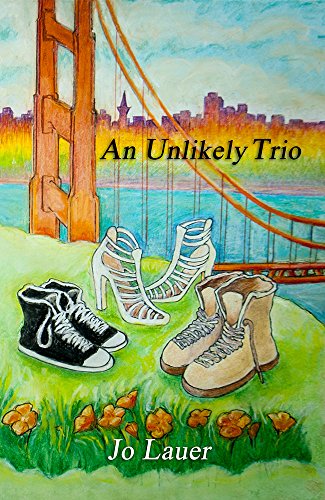
That seemed to call for a prequel at a time folks were requesting a sequel. From that, An Unlikely Trio emerged, taking us back into the lives of the three main characters and watching Fate have its way, connecting them in the bigger picture. Again, I had no idea where we were going. This book ended with a natural segue into Best Laid Plans, which still begged for some sort of ending beyond the cliff-hanger.

The social worker sidled up to me one morning while I was washing the dishes and said, “Don’t you want to know what happened?” Well, yes, but I didn’t have a clue as to how to figure it out. “The key is in the crazy,” she said. 

Eventually, the octogenarian stepped forward to reveal her story. As a therapist myself, I’m fascinated by how people “turn out” from their early beginnings. Her story became one of “the wounded narcissist,” and took me to the conclusion of the book, Gone Awry, stumbling along the way over a horrific plot change that I didn’t see coming.

By the end of the third book, in what had now become a trilogy, we were done. There was nowhere else to go. All the ties between the books had been made, nothing left dangling over the cliff, nothing unresolved.

But then… hindsight being a great teacher and at times my worst nemesis, I wondered if it would have made more sense for all these books to be rearranged and combined into one. Will the journey never end?

I still don’t know if I’m done.

____________

An Unlikely TrioAuthor Bio:

Jo Lauer’s articles and essays have appeared in numerous journals and anthologies.

She is the author of “Returning: A Collection of Stories,” and three novels: An Unlikely Trio (Prequel to Best Laid Plans), “Best Laid Plans (A Cozy Mystery), and “Gone Awry. She is also the author of three novellas: Waltzing With the Azaleas, Grapevine, and Sojourner.

Jo is a psychotherapist by day, and lives in Santa Rosa, California, with her stuffed raven, Loudly. Please check out her website at www.jolauer.com.


~~~

Read Thonie Hevron’s books:

Cop loc auth close up

Malice cover

By Force or Fear, Intent to Hold,

and With Malice Aforethought

are available through Amazon.

Categories
Writer's Notes

When is it “The End?”: Kay Mehl Miller

You’ll Cry Too by Kay Mehl Miller, author

K Mehl Miller novel coverMy best works leave the reader asking, “ And then what happened?”

Take my latest book Ring Around Reality: A Novel. The first time I wrote it 37 years ago, I came to the end, put my head down on my typewriter and cried and cried and cried.  Why was I was I crying?  I’m not going to tell you, but I bet you’ll cry too when you read it.  I’ll give you a clue, though.  The novel is based on my alcoholism— I’ve been sober for 44 years now. But that is me, not necessarily my character Diana Lossen.

How come it took 37 years before the book was published?  Because I was intimidated by it. The facts, which I turned into fiction, were stark, a reality for most practicing alcoholics. My family of origin was bound to be impacted, so I didn’t publish it.  In 2014 the last of  that family died. I took down the hefty manuscript and spent over a year rewriting it, changing the title, some character names, and a lot of this and some of that, honing and polishing until I was awed by my own writing. In the end I bowed my head over the computer keyboard, this time, and cried and cried and cried.

Am I still intimidated by the book? You bet I am. Every time I do a reading, I wander what is in the mind of my audience. At my last reading, I glanced up after I read about four-year-old Diana’s mother throwing her child’s new red wagon in the swamp. I saw horror on the faces of most of my audience and later was asked how a mother could do such a thing.  I knew then that people in that audience would read the book to the end to see if there is an answer to their question.

On the way through the book, my audience will find significant character flows in Diana, vividly described. Parents will hide this book from their children. I will hope that my readers will discriminate between my character Diana and me, and yet, I write about the things I know.

If you are wondering how you will know when your book ends, try crying.

__,_._,___

Kay Mehl MillerKay Mehl Miller,Ph.D. was a newspaper reporter, intermediate school English teacher a columnist for LGBT media and, eventually, a psychotherapist in Hawaii. Besides Ring Around Reality, she is the author of two creative non-fiction books: Talking it Over: Understanding Sexual Diversity and Living with the Stranger in Me: An Exploration of Aging. Her first novel is Love Comes at Twilight: A Love Story for Seniors. She has written two plays, one of which was produced by Santa Rosa’s Sixth Street Playhouse.


and the links.

www.amazon.com 

www.kaymehlmil.com

~~~


Cop loc auth close up Malice cover

Read Thonie Hevron’s books:

By Force or Fear, Intent to Hold, and With Malice Aforethought are available through Amazon.

Categories
Writer's Notes

When is it THE END?: Nicholas Chiarkas

WEEPERS COVERBy Nick Chiarkas

Although I love the idea that, “Art is never finished, only abandoned” (Leonardo da Vinci), as an author I nevertheless must decide when to type “The End.”

To be clear, when writing a non-fiction book, I pretty much know at the start where it will end. But as a novelist, deciding when the book will end is more an agreement between me, the story, and one or more of the characters.

When writing a novel, I write, “The End,” at least twice. First at the end of my initial draft. I then wait two weeks before I look at my draft again and begin the rewriting process. This is the art and the heart of it, this is when I get to build castles (“I’m writing a first draft and reminding myself that I’m simply shoveling sand into a box so that later I can build castles.” ― Shannon Hale). These are the rewrites I can share with my initial reader, and later with my editor and publisher.

When rewriting openings and closings to each scene, I ask, “Why would the reader want to read on?” and “Why did I start and end the scene with that line or in that way?” The opening and closing to each chapter is even more important. And as crucial as they are, asking “why” at the opening of the book and at the end is monumentally more critical.

In “Weepers” I made four promises to my reader.

First, through foreshowing I promised the coming of an event. For example, in chapter one, which takes place on Christmas Eve, Angelo asks his father why no one has stolen the three Christmas trees on the Journal American Newspaper loading platform. His father answers, “They belong to Uncle Nunzio.” The reader has not met Nunzio yet, but I want her to assume that Nunzio is not someone you should cross. I make a check-off list of all of my foreshadowing, as well as other promises, for my final draft review.

Second, through character development, I promised a change or some other action in one or more characters. For example, in chapter two, Angelo’s mother, Anna, tells Father Joe (her priest) that Angelo is changing and becoming more like the projects in which, they live. I now have an obligation to my reader to show that change to a reasonable degree and at a believable pace.

Third, through each major character, I promised a consistency that rings true. So, while in my first draft, “the end,” was a resolution for all main characters, such an ending would have been a betrayal to Angelo, Anna, and a couple of other characters. To make that ending ring true, I would have had to jump ahead by means of a prologue that I fear would have felt like a ploy to my reader. In addition, since “Weepers” is both a stand-alone novel, and the first in a four-novel series, I had to decide which sub-plots to wrap-up, and which ones to dangle in an effort to create anticipation for future novels in the series.

And fourth, I promised the resolution of mysteries. Describing “Weepers” in 15-words I would say that a, “NYPD cop killing in 1957 has unexpected ties to a young father’s disappearance in 1951.” So, here I must unravel the killing of a police officer, the disappearance of a young father, and the six-year link between them. I must do this with suspense, reasonable surprise and intrigue. And at the same time, my reader must not feel cheated (no bolts of magic, dreams, etc.).

In short, by the end of the novel, in addition to answering questions raised during the story and meeting expectations, I must do so without disappointing my reader. Consequently, after first writing an ending that wrapped everything up in a nice buddle, my initial reader (my wife Judy Olingy) said, “No, no, Angelo and Anna would not respond this way. Consider ending here (sooner).” She was right. I cannot over-state the importance of a good initial reader and editor.

Finally, as I said above, “Weepers” is the first of a four-novel series, but I also want it to stand-alone. Therefore, some questions and foreshadowing remain, however, it is crucial that they are not detrimental to a free-standing story.

In the end, I want my reader to say, “That was a good read, a satisfying ending, and I would like to read more about the Weepers, Angelo, Nunzio, Anna, and others.”

~~~

About Author: I grew up in the Al Smith housing projects in the Two Bridges neighborhood on Manhattan’s Lower East Side. When I was in the fourth grade my mother was told by the principal of PS-1 that, “Nick was unlikely to ever complete high school, so you must steer him toward a simple and secure vocation.”  Instead, I became a writer, with a few stops along the way: a New York City Police Officer; the Deputy Chief Counsel for the President’s Commission on Organized Crime; and the Director of the Wisconsin State Public Defender Agency. On the way I picked up a Doctorate from Columbia University; a Law Degree from Temple University; and was a Pickett Fellow at Harvard. How many mothers are told their child is hopeless? How many kids with potential simply surrender to desperation? That’s why I wrote “Weepers”—for them.


Website: www.nickchiarkas.com   Also visit Nick’s: Amazon Author Page and Goodreads Author Page

Facebook:  www.facebook.com/NicholasChiarkasAuthor/?ref=aymt_homepage_panel

You Tube:  www.youtube.com/channel/UCjn5mfHw0Jo8DMrXdG2QeSw

Weepers Trailer:  https://www.youtube.com/watch?v=w6RTOr9gB3E

Available: Weepers by Nick Chiarkas is available at Amazon.com, Barnes & Noble, University of Wisconsin Bookstore, Mystery to Me, other local independent bookstores, and from the publisher.  Amazon  Barnes and Noble  https://www.mysterytomebooks.com/weepers   http://www.uwbookstore.com/   www.henschelhausbooks.com

Chiarkas2015-7

MIPA_Medallion_r1PSWA Writing contest awardBookvana_FINALIST Small Sticker

~~~

Read Thonie Hevron’s books: By Force or Fear, Intent to Hold, and With Malice Aforethought are all available through Amazon.

Malice coverCop loc auth close up


Categories
Writer's Notes

When is it THE END?: Terry Shames

T Shames Unsettling Crime_coverNot So Fast, Honey by Terry Shames

Done! Finished! The End!

I wrote several novels before I got published. When I sent them off, publishers said, “Close, but no cigar.” I always thought that if I wrote just one more book, the new book would leap the hurdle. I thought secretly, as I know many pre-published authors do, that it was “them,” not me. It took an important workshop to force me to reconsider. In the workshop, author Sophie Littlefield cautioned that if we were writing one book after another and not getting published, we ought to consider that it was not “them” (publishers) at all—it was the book. She said she knew from personal experience because she had written many books before she finally hit her groove. She urged aspiring authors to reach deep inside to write the best book we could write.

Immediately after the workshop, I came up with the idea of the Samuel Craddock series. It seemed as if it had always been there, waiting for me. I gave the first book to my writer’s group to read, and they loved it. They said I had finally found my voice. The only problem was that the end came too fast. It wasn’t the first time this criticism had been rendered in the books I wrote, but it was the first time I took it seriously.

This time I really pondered what I had to do to satisfy readers. What did not work in the end? I realized it wasn’t what I had written that was at fault, but what was left unwritten. In general, the book had depth, so what was missing? If I had gone back to my old habit of simply dismissing the critique as irrelevant, I would most likely have missed what now seems to me to have been the obvious “real” ending.

Last year, when I wrote the sixth book in the series, An Unsettling Crime for Samuel Craddock, I hoped I had finally mastered getting to the end. I was satisfied when I sent it off to my agent. Not so fast, honey! My agent said it wasn’t really finished. After grumbling to myself that it couldn’t possibly be true, I knuckled under yet again. I asked myself these questions:

1)    Have I resolved every aspect of the crime? In one of the books, I had hinted at the resolution, but had not put it in an actual scene. I realized that it’s important that the reader have the catharsis of being present for the resolution. In “Unsettling,” the answer was no, I had not resolved every aspect, but I had accounted for why it couldn’t be so—it was in my original intention.

2)    Had I met my original intention? Sometimes in the writing, a book strays from the original goal. This is okay, but the end needs to address what actually happens in the book.

3)    Have all the characters been accounted for? In the first book in the series, I added the last chapter after my critique group said it felt unfinished. I didn’t know enough to actually ask myself these questions, but by luck I came up with a “finishing” chapter that accounted for a character who had slipped away. And this turned out to be the answer to how to finish An Unsettling Crime for Samuel Craddock. One of the characters I loved had simply dropped off the page. It took staring into space and really considering how to bring her back in before the answer came to me clearly. I actually cried when I got to the real end.

Had I depended only on myself to get these books right, the ending to all of them in the series would have been stunted. Why can I not see this for myself? I think it’s because I’m so glad to get to the end, that I stop writing the best book I can write, and just write a “good enough” book—the kind that got rejected again and again before I got published. That’s where a good critique group or a good agent who reads critically comes in. I keep hoping that one day I will be able to ask those three important questions on my own, but until then I depend not on the kindness of strangers, but of people I trust to help me get it right, all the way to the end.

~~~

Terry Shames writes the award-winning Samuel Craddock series, published by Seventh Street Books. It’s her understanding that fans of the novels fall into two categories: women want to marry Samuel Craddock, and men want to be him! Find more about Terry on her website, www.terryshames.com. You can also find her on her author Facebook page, https://www.facebook.com/TShames/.

~~~

Cop loc auth close upMalice cover

Read Thonie Hevron’s books:

By Force or Fear, Intent to Hold, and Malice Aforethought are available through Amazon.


Categories
Writer's Notes

When is it THE END?

WMA on AmazonBy Thonie Hevron
I’ve written four books (three published) now, so I feel like I should know a bit about story-telling. But here’s the thing: they’re all different. My first book, By Force or Fear, wrote itself. I struggled with details but the story was already in my head. Still, the ending was problematic. I had a huge climax scene imagined with a mudslide taking the heroine’s storm ravaged-house down a hillside. But I got to the end and decided that instead of a random act of nature, I had to serve red-hot justice up on the villain. I wanted the heroine to shoot him in self-defense. I eventually decided against that because I didn’t like the improbability of this heroine (a sheriff’s deputy) shooting two people in this book. Statistically, very few law enforcement officers shoot people (in direct contradiction to the CNN headlines this morning about cop shooting deaths topping 1,000 this year, as in two previous years). The bad guy’s eventual death was at the hand of one of his henchmen (really? Does anyone use that word?). A kind of retribution for the villain and redemption for the henchman. When asked why, he said, “I couldn’t let him kill a cop.”
Intent to Hold took me a year to write, front to back. I’d had years to consider this sequel and by the time I sat down, the story poured out. Easy-peasy.

Not so with With Malice Aforethought. I wrote this story around a single scene I’d had in my head for years. The rest of the plot I had to work on. I completed the story in 2015 submitted it to Public Safety Writers Association Contest (PSWA) in unpublished novel category. I won second place and sent it to my publisher. She sent me a contract, which I signed and returned. Unfortunately, she suffered a persistent health problem that resulted in returning my rights. Something bugged me about the ending, even though my publisher liked it and so did PSWA, I got back to work on it. It took me almost a year to get it right—and then, it was with the help of my critique group. One member, Andy Gloege, is particularly adept at finding the path not taken. He wrote a couple of paragraphs that took Malice in an entirely different direction. Yet it was where the characters were going!

I cannot stress enough how important it is to listen to other professionals, particularly those close to you. Andy had been through three books with Nick and Meredith. He knew them almost as well as I did. Armed with his suggestions, I wrote the ending of Malice with a smile on my face. I knew I’d gotten it right this time. Two years later.
A writer’s journey will always be a forward motion. If it isn’t, get help. Talk to other writers, readers who you can trust, professional editors, agents. Read books by Donald Maass and Stephen King. Read blogs like Jane Friedman or this one!

Today, I begin Friday’s Writer’s Notes with guest authors’ thoughts about when their stories are over— “When is it THE END”? You’ll hear from writers in many genres: detective mysteries, historical romance, cozy mysteries, memoir and police procedurals. This topic was so popular that there will be posts on Wednesdays and Fridays as well as our normal cop vignettes on Sunday mornings.
In August, I’ll return to Friday Writer’s Notes and Sunday cop posts.


~~~

Read Thonie Hevron’s books: By Force or Fear, Intent to Hold, and  are all available through Amazon. With Malice Aforethought will be in print soon, now available in eBook on Amazon.ad-in-thin-blue-line