
 By Ed Meckle, Retired LAPD
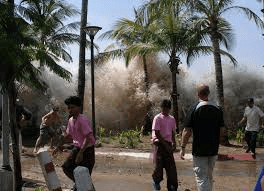
Prior to December 26, 2004 I had never heard the term tsunami. Watching film as the walls of water from the Indian Ocean swept thousands to their deaths was almost too much to comprehend.
Caused by a 9.0 earthquake in the Indian ocean off the West coast of Sumatra it had the energy of thousands of atomic bombs. Within hours killer waves slammed into the coast line of eleven countries from East Africa to Thailand, traveling thousands of miles, they destroyed cities and killed an estimated 227,898 people.

That said, let me tell you of the great L.A. tsunami. Many, many years prior I was working Metro; a bachelor living the good life in Hollywood. As I recall it was hot. Summer? Who can tell in LA? It was morning and I was scheduled to work that night. The call from the office told me to report ASAP in Class A uniform, emergency and bring your rain boots. Rain boots??
An hour later I was on one of many buses rolling out of the main police building. We were briefed as we went. My partner could not be found so I was paired with a non-Metro officer who I do not know and who was probably scooped up when they were frantically looking for blue suits. The non-Metro sergeant told us a major earthquake in the far Western Pacific near Hawaii had produced a large tidal wave which was expected to hit the LA coastline at an unknown time—time estimates kept changing.
Now the rain boots made sense of course. A massive wall of water is about to hit the city and I had a pair of boots which end at mid-calf. Sure. Why not?
We were to locate and warn as many people as possible and to provide assistance as necessary. They dropped my partner and I together with the sergeant at some small boat marina. We were on foot, no vehicle and no radio, no method of communication. The sergeant tells us to spend not more than one hour warning as many people as possible and then get out, find high ground.

“High Ground?” We were at the beach for God’s sake and we didn’t have a car. Assuming the boat house or whatever will have a P.A. system we head there. The 18-year-old minding the store said he had to find the owner to get permission for us to use the loud speaker. I told him he has three minutes or else. I have no idea what or else was, but it sounded good. Two minutes later I was on the PA system trying to keep it low key but informing one and all there was trouble coming. The civilian radio had broadcast a warning or warnings earlier in the day. When I was finished with the PA several people on the docks looked in our direction and then went on about their business. One middle aged lady actually came into the office and wanted to know if we were really policemen.
 Within the hour we joined the sergeant on the roof of a nearby two-story building.
We waited for the magic hour as it approached, then passed. Nothing, absolutely nothing. The buses finally picked us up and we went back down town in silence feeling for all the world like fools. Nobody knew anything. At the office we were told the wave slowed and then died somewhere in mid Pacific—they thought.
I took my boots and went home.

 By Gloria Casale
 About Gloria Casale

 Parker Center was many things to many people but revered by those Chief Parker commanded. Standing alone at 150 N. Los Angeles Street, the building occupied the entire block with an imposing position in Civic Center.
 During its life the building saw the likes of the Manson Family, the Night Stalker, the Hillside Strangler, Skid Row/Central Slasher, Lonely Hearts Killer, Mickey Cohen, O.J., the Onion Field Killers, the Remorseful Rapist, Robert Blake, the killers of Robert Kennedy and Sal Mineo, and so many, many more.

 In the most recent published tale, A Cold Death, the ghost of a young girl seeks Tempe’s help.
 A Cold Death
 October 1, 2017 will always be remembered as
  The murderer killed himself. The shooting stopped, and the sun eventually rose that Sunday morning. All anyone could see were the remnants of the carnage that covered an extremely large crime scene; the likes of which few law enforcement officers had ever seen.

 In this first book of the series, Dumpster Dying, Toby tries out schemes with local criminals—informant to drug traffickers, gofer for a kidnapper and clean-up man to a killer. He gets caught and tossed off the police force. While waiting for his trial, Toby moves to a shack in the swamps and grows a beard but continues his messy habit of chewing. His white beard takes on the color and odor of tobacco. Toby had become even more pathetic, yet I found it impossible to toss him out of my next book. I decided he was too wonderful (as in horrifyingly fascinating) a character to dump, so I put him to use as a police informant, earning his way out of a jail sentence by helping Detective Lewis track down the killer of a barbeque cook-off contestant. Grilled, Chilled and Killed might have offered Toby redemption if he accomplished what he was assigned. Instead he almost destroyed Lewis’ case by tampering with evidence and, to make money on the side, participating in a kidnapping scheme arranged by an international criminal. Toby may have gone big time, but his abilities hadn’t, and he faltered in both of these endeavors, his downfall helped by the story’s protagonist who was aided by a feral pig. End of Toby? No, not yet. It was time for a third dose of bad boy Toby.
 did not because, although he is a bad boy, he has staying power in terms of being a character readers seem to love to revile. Like me, I think readers feel a bit sorry for Toby. Rehabilitation is always an option.
 In many of my books, I’ve let other “bad darlings” sail off to foreign ports or fly off to an uncertain fate in South America. What’s wonderful about not killing them is that I can bring them back for another dose of their badness and perhaps a final measure of justice at the hands of one of my sassy country gals.

 Here then are two completely unconnected events in the life and times of Ed Meckle.
 I have tried to be as circumspect as possible with what follows out of respect for any female readers.
 By Judy Alter
 About Judy Alter
 It was 1993 and I was working Rampart morning watch patrol as a field supervisor. I had a lot of fun there. One particular shift at about 0100 in the morning an “officer needs help” call went out at 6th Street and Bixel. On the LAPD, calls go this way in order of severity: “Back up,” means ‘no need to rush but get there ASAP.’ An officer “Requesting assistance,” means ‘get here quicker than ASAP.’ “HELP,” yeah, send everyone and everything instantly, or sooner.
  The next night I went back to the location at about the same time to see if I could find any potential witnesses–someone who may have left to avoid involvement from the prior evenings incident. There, on a bus bench, I found a homeless man and his dog. Mike and his dog Queenie had been there the night before and had seen the incident. Mike said he had seen the suspect fighting with two other men and one of the men struck the suspect in the head with a long object. The suspect fell to the ground and the two men fled. Shortly after that the officers arrived. Mike said the man attacked the officer. He said the officers used physical force only. From his bus bench, his view was unobstructed with good lighting.
  We got there shortly after it had opened. To my surprise there were a lot of folks there, mainly gang-type folks. A vice unit had taken down a pit bull fighting ring and these folks were there to bail out their dogs.
 “In writing, you must kill all your darlings.”
 Kristen Keiffer writes in